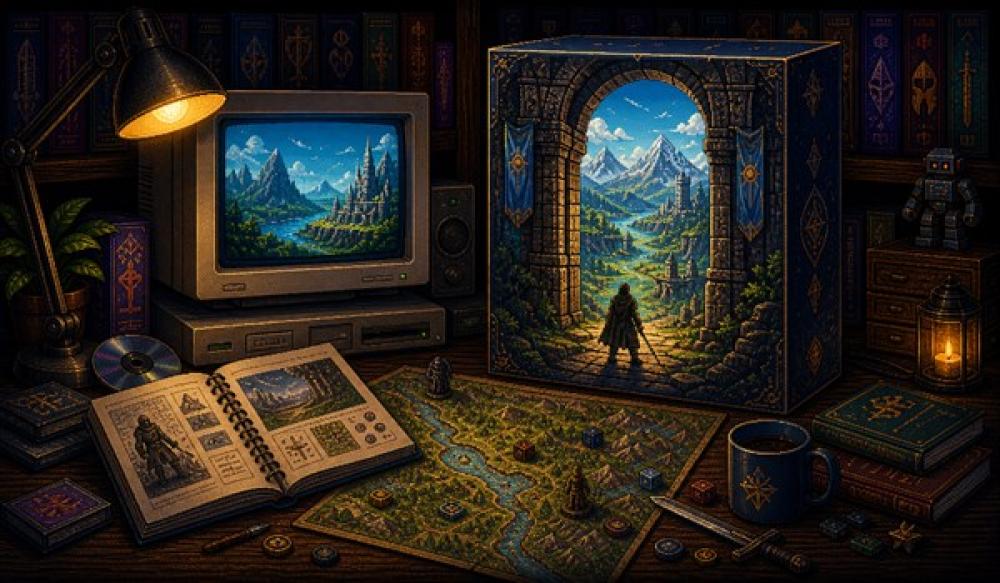

(Illustration: GamingPlanet.nl)
Almost twenty years after the original release, the gate to Cyrodiil is open again. Bethesda has released The Elder Scrolls IV: Oblivion Remastered for modern systems today.
Some remasters feel like housekeeping. A higher resolution, a cleaner menu, maybe a controller layout that finally behaves. Oblivion Remastered seems to be aiming for something more delicate: keeping the old, slightly awkward charm of Oblivion visible, while freeing the technology around it from 2006.
That is exactly why this belongs on GamingPlanet. Not because every re-release is automatically interesting, but because Oblivion sits in such an odd place in western RPG history. One foot was still in the classic PC role-playing tradition. The other was already in the console era where open worlds became mainstream.
For many players, this was the first fantasy world that felt less like a level and more like a destination. You left the prison, saw the hills, forgot the main quest and three hours later found yourself in a cave with a stolen fork, a disease and a faint suspicion that you were supposed to be doing something else.
Bethesda calls the new version a remaster, not a remake. That distinction matters here. According to the studio, the project began in 2021 and was made together with Virtuos. Art, animations, effects and large parts of the world were reworked. At the same time, the heart of the game had to remain recognisable: still that strange mix of grand prophecy, stiff faces, sudden side quests and conversations that stand just a little too close to you.
The systems have been adjusted too. Controls are meant to feel more modern, progression and balance have been smoothed out, and some new voice work has been added without sweeping the old material away. That sounds small, but in a game like Oblivion the value often lives in the friction. Remove too many rough edges and you are left with a tidy museum version.
The full package also includes Shivering Isles and Knights of the Nine. Shivering Isles in particular is more than a bonus. It is one of those expansions that reminds you how colourful and strange big RPGs could be before everything was pushed toward cinematic seriousness.
The easy story is obvious: old game returns, old players happy. Beneath that is something more interesting. A successful remaster shows which games have enough shape to remain recognisable a generation later. Oblivion had technical limitations, odd AI moments and dialogue that became meme material, but it also had a strong identity.
That identity is harder to preserve than textures.
An original DVD on the shelf still matters, especially with the manual and map. But that is only half the story. If a game no longer runs comfortably on modern hardware, it slowly leaves everyday play and becomes mostly an object. A good re-release can act as a bridge: not a replacement for the original, but another way to keep the same world reachable.
There is a risk in that. If only the polished version remains available, the original can fade into the background. The best outcome is not that remasters replace old games, but that they make people curious. Someone plays Oblivion Remastered, wonders why the old release had such a reputation, and then starts looking for the original box, old patches, the mod scene and the stories around it.
Oblivion Remastered is available today on Xbox Series X|S, Game Pass, PlayStation 5 and PC. That broad release helps. A game that once felt like a showcase for new hardware now becomes an easy route into an older RPG tradition.
For collectors, the original release remains appealing. The box, the map, the manual, the expansion discs: those are physical pieces of 2006. But for players who mainly want to understand why people still talk about Cyrodiil, this remaster is a sensible place to start.
Not everything from the past needs to stay sacred. Sometimes an old game can have a new pair of shoes, as long as it still takes the same strange walk.
For more RPGs, MMOs and classic PC role-playing games, visit the new Retro PC RPGs hub.
Sources: Bethesda release announcement, Bethesda Game Studios on the remaster.
Tags: News, Bethesda, Elder Scrolls, Retro gaming, RPG