
(Illustration: GamingPlanet.nl)
Sometimes gaming history does not return as a remake, a mini console or an anniversary trailer. Sometimes it comes back through an old business decision that looks much larger in hindsight.
The most interesting SEGA news this week takes place on 15 July 2026 in Akihabara. Nvidia and SEGA are marking thirty years of shared history with a small event at GiGO Akihabara. Jensen Huang is attending, Nvidia is showing RTX Spark to the Japanese public, and guests even have a chance to win a GeForce RTX 5090 Founders Edition.
At first glance that sounds like modern hardware news. A CEO, a new chip, an expensive graphics card, an event in Tokyo. The reason it belongs on GamingPlanet, though, is not the shine of 2026. It is the messy bend in the road somewhere in the mid-nineties.
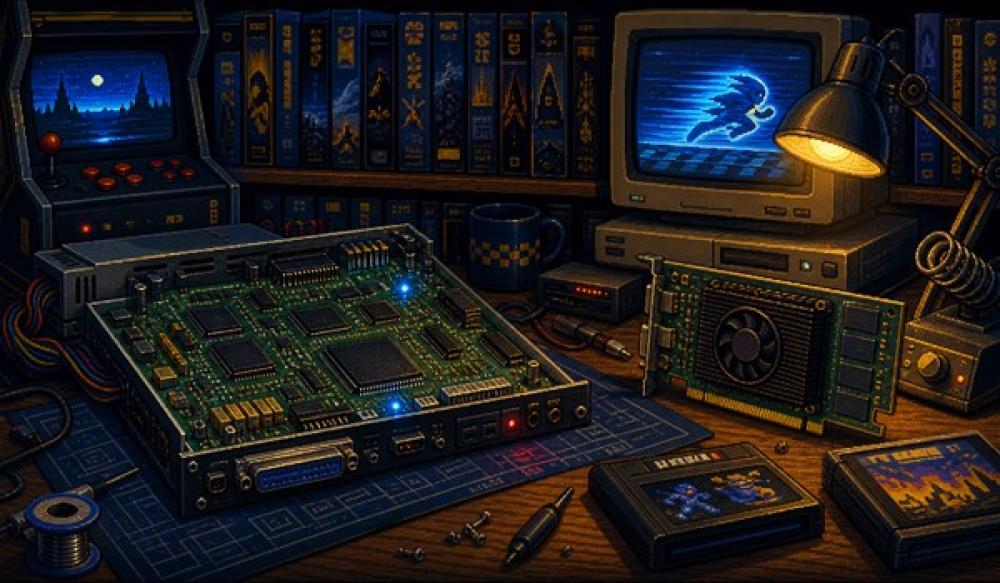
Nvidia was not yet an obvious name in those days. The company was working on early 3D hardware and became tied to SEGA through the NV1. That chip appeared on Diamond Edge 3D cards, complete with ports for Sega Saturn controllers. It was an odd crossing of wires: PC gaming, arcade habits and console controls sitting in the same box.
Nvidia was then supposed to help with graphics technology for a new SEGA console. That work did not land as planned. The technical choices were poorly matched with the direction PC graphics and DirectX were taking, and SEGA eventually moved on to another solution for the machine that became the Dreamcast.
Most stories like that disappear into a footnote. Contract fails, supplier leaves, another partner is found. This one took a different turn. SEGA did not simply let Nvidia fall away, but put five million dollars into the young company, according to the well-known account of that period. For Nvidia, that was not a friendly bonus. It was breathing room.
That breathing room turned out to matter. Nvidia changed course, released the RIVA 128, and later became almost inseparable from PC gaming through the GeForce line. The funny thing is that most players buying their first proper 3D card in the late nineties probably were not thinking about SEGA. They were thinking about higher resolutions, smoother framerates and games that no longer looked trapped in software rendering.
Still, beneath that development sits a piece of SEGA history. Not the kind you immediately see on a cartridge, disc or arcade cabinet. More the kind that lives between prototypes, boardrooms and technical side roads.
That makes the 15 July news more appealing than a normal anniversary event. Nvidia is not only thanking an old partner. It is also a reminder that gaming history is full of almost-moments: hardware that did not ship, chips that were not chosen, agreements that later turned out to be just enough to push another company into the future.
Because SEGA is involved, imagination immediately starts making noise. A new mini console? Saturn or Dreamcast hardware? Something arcade-related? The reporting around the event is much clearer about Nvidia's plans than SEGA's. Nvidia has RTX Spark and the graphics card lottery. SEGA's own role is less concrete.
That is fine. Not every SEGA moment needs to become a product announcement. Sometimes it is more valuable to pause over the strange way this industry was built. The Dreamcast did not lose the console war because it lacked character. The Saturn did not become less interesting because it was difficult to develop for. Nvidia did not become important because every early plan was perfect.
The rough edges are the interesting part.
When we talk about game preservation, it is easy to think about playable games, boxes, manuals and old patches. That is fair. But stories like this belong there as well. A controller port on a half-forgotten PC card, a cancelled console chip and an investment that few people at the time would have treated as historic: together they explain why the industry moved in a particular direction.
That is why this news is quietly charming for retro fans. Not because it instantly gives us a new SEGA machine. Not because an RTX 5090 has much to do with the Saturn. But because it shows that even the polished modern hardware world still carries traces from the age of beige PC towers, fuzzy 3D accelerators and consoles trying to overtake each other at full speed.
SEGA has not been a console maker in the old sense for a long time. Moments like this show that it can still sit under the floorboards of gaming history. You do not always see it, but part of the room would have been built differently without it.
Tags: SEGA, Nvidia, Retro gaming, Preservation, Hardware