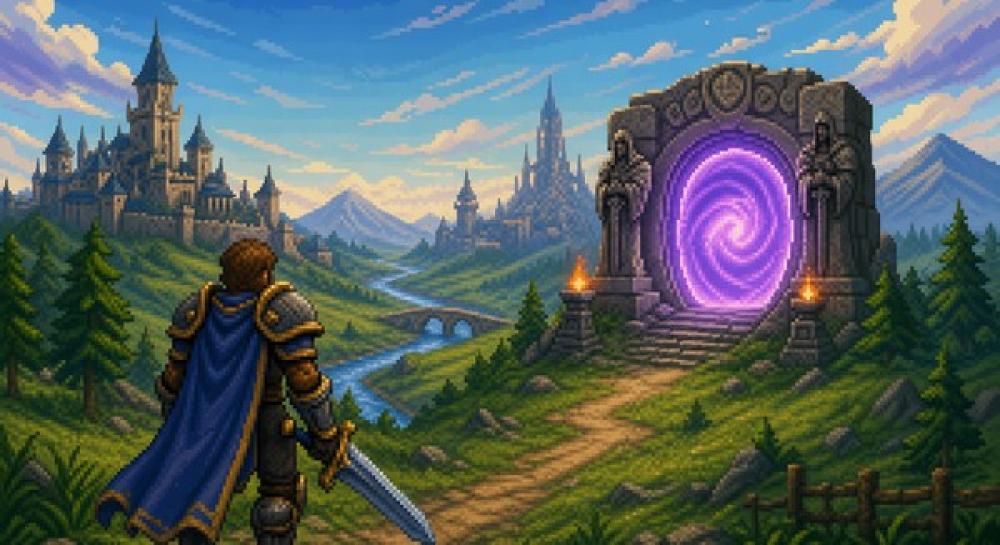

(Illustration: GamingPlanet.nl)
UPDATE: 18-07-2026 Project Ascension, Blizzard's lawsuit and renewed pressure on modern WoW private servers have been added as a separate note at the bottom. Jump to the note.
The history of World of Warcraft emulation is messy, technically fascinating, and partially lost. It is a story of reverse engineering, small teams, big egos, vanished websites, legal pressure, and endless rewrites. Many projects lived only briefly, yet still left behind ideas, code, tools, or knowledge that resurfaced years later in other emulators.
Anyone who reads old forum posts, archive pages, and project overviews quickly notices that there is no single perfect source. Some stories contradict one another. Others are clearly colored by the rivalries of the time. And a great deal of knowledge never lived in neat documentation at all, but on IRC, in private channels, on forums like GotWoW and Blizzhackers, or simply in the memories of former developers. That is why this article does not try to act like a courtroom-grade dossier. Instead, it aims to be the most complete and readable reconstruction of how the scene later remembered itself.
That history matters for more than just people who once ran private servers. It also shows how early internet communities worked: how people with limited tools tried to dissect a closed game, how technical findings spread at incredible speed, and how projects could collapse the moment one key person disappeared. It is game history, internet history, and a case study in how fragile pioneering work can be.
Almost every early reconstruction begins with Skull. According to community lore, he managed to obtain an internal World of Warcraft alpha client near the end of 2003. Exactly how remains unclear. Some versions talk about a failed plan to hack Blizzard, while others suggest contact with someone on the inside. What is clear is that once the client leaked, everything changed. The alpha started circulating in small circles and through torrents, and suddenly the scene had something concrete to analyze.
That did not mean people could play right away. There was no public server implementation, and even packet data was limited. The first major challenge was not how to build a complete server, but how the client talked, logged in, and entered the world at all. That is where the real history of WoW emulation begins.
The key figure in that first technical phase was Lax. Some later sources say he started with only a few packet captures and the alpha client; others suggest he barely had usable logs and mostly had to infer things from the client itself. Either way, he was the person who first moved the scene from curiosity to a working foundation.
That work produced an early server line often referred to as Abyss, alongside a simple sandbox that already allowed people to explore parts of the world. That sandbox later became associated with Stormcraft Sandbox. Whatever the exact order was, the core point remains the same: Lax created the first real technical breakthrough. For the first time, WoW emulation became more than rumor, theory, or packet collecting.
When Lax stepped away and returned to other projects, other developers carried the work forward. Names that keep reappearing in the early archives include Generin, _Psycho, TheUndying, TheDamned, Alita, Cain, and later Codemonkey. From that continuation grew Stormcraft, which in the memory of many former community members became the first truly major name in WoW emulation.
Stormcraft was more than a proof of concept. It became a project with real ambition: architecture, world entry, public tests, pathfinding, spells, movement, and experiments with larger player counts. Some recollections even claim public tests with around two hundred users at the same time, something genuinely impressive for that period.
Codemonkey played a special role in that phase. While many others relied heavily on packets and protocol analysis, he was remembered as someone with deeper knowledge of the executable itself. That made it possible to implement features for which packet captures were scarce, such as taxi nodes and other client-side logic. It showed early on that emulation was never only about packets, but also about understanding the client at a deeper level.
This was also the phase in which the first myths of the scene began to form. In old interviews Lax is often framed as the “father of WoW emulation,” while Skull is described as the original spark. That is partly mythology, but not without reason: without the alpha leak and without Lax’s technical groundwork, the early scene would almost certainly have looked very different.
Once the first working experiments existed, the scene grew quickly. The most important hub in that period was GotWoW. It was not just a forum, but a central meeting point for tools, discussions, subprojects, servers, and documentation. In later retrospectives this phase is often described as the glory days of WoW emulation: the period when everyone still seemed to be helping one another, knowledge circulated relatively openly, and almost anything felt possible.
In the first months of 2004, Stormcraft even briefly released a spell database extracted from the alpha client, along with a login/loader tool that made it easier to connect to test servers. At the time these tools were not minor extras. They were essential, because the barrier to entry was far higher than it would be in later private-server ecosystems.
Around GotWoW, a wide range of supporting projects also appeared. WoW Places collected locations and media from alpha and beta. Technetium focused on BLP2 conversion and texture tools. VJeux tools offered loaders and utilities for connecting to test servers. These side projects may seem small in hindsight, but they show that WoW emulation was already about far more than just “a core.” It was an ecosystem of tools, data, and research.
Creator: AlexM
Programming language: Visual Basic
Status: Discontinued
Rift stood out because it was carried almost entirely by a single developer. AlexM wanted to prove that even Visual Basic could be viable for a WoW emulator. The project got chat, world entry, and creature spawning working, but players still could not see each other. Even so, Rift mattered because it demonstrated how broad the experimental spirit of the early scene really was.
Creators: Stanz and Larael
Programming language: Delphi
Status: Discontinued
Future WoW, usually shortened to FWoW, remained closed source throughout its life and is therefore harder to reconstruct than many other projects. Stanz started it, and Larael later rewrote large parts of the core to make it more stable and more functional. What made FWoW interesting was that it seemed less obsessed with always chasing the latest client and more focused on building a solid gameplay experience on an existing version. That gave it a distinct reputation within the early scene.
Team: Addictman, Battyone, DeathCheese, Deten, don, FreXX, Hedos, Jedite, jimmy, Munky, page_420, RandomGuy, tmm`, WantedMan, angelic666, c0mputar
Programming language: C++
Status: Discontinued
Despite the name, Team Python worked in C++. The project built a great deal from scratch and became one of the most important open-source lines of the early scene. Features such as vendors, mounts, items, combat, time changes, gryphon flying, and a large number of GM commands made it strikingly advanced for its time.
Its afterlife mattered even more. Team Python later lived on, was rewritten, and was forked into projects such as WSD and eventually WOWD. In that sense, Team Python was not just a temporary project, but a source line with lasting influence.
Team: Foole and Scar
Programming language: C#
Status: Forgotten side branch
One often overlooked name from the early years is 0x90, a prototype server mostly associated with Foole. The working branch ran in C# and included chat, parties, mobs, and combat. It never became as famous as Stormcraft or Team Python, but it shows just how diverse the emulator landscape had already become.
Team: Daxxar, Pasn, Trivex, Xetrov`, Archang3l, Warren, [pez]
Programming language: C++
Status: Discontinued
Warforge was already mentioned in the earliest reports surrounding the leaked alpha. Because of that, it gained an almost mythic status from the beginning. At the same time, remarkably little hard information survives. Most later accounts describe Warforge as technically serious, but almost entirely private. That left it as more of a shadow-name in the history than a project the wider community could truly follow.
Team: DMod and others
Programming language: Not documented consistently, often described as a C# line
Status: Discontinued
Khaos is often remembered as one of the first projects to clearly separate login, realm, and world services. That model would later become standard. According to community recollections, Khaos supported movement, creatures, custom item data, quests, flight paths, and combat, but remained mostly private and disappeared before it ever became broadly public.
Team: McKay34 and Spr4ttel
Programming language: C++
Status: Discontinued
Vibe was remembered as a technically strong and relatively stable project. Within the scene it earned a reputation as one of the more mature efforts of its time. Like several other projects from that era, it vanished under legal pressure and because so much development remained private or fragmented. That only added to its legend later on.
After the first wave, the scene increasingly split into families and lineages. That is one of the hardest parts of this history to untangle: not individual projects in isolation, but the way code, ideas, and developers kept moving from one team to another.
Team: Codemonkey, Foole, Tharaxis, Benjou, and others
Programming language: C#
Status: Discontinued
WoWDaemon gained an almost mythical reputation early on. It brought together strong names and aimed to become a flexible, mature emulator. At the same time, historical accounts describe internal friction, especially around the fact that Codemonkey handled a great deal of the coding himself and not always in a way that suited the rest of the team. Eventually that led to a split.
After the split, an older source version became available. That did not end the lineage. It created new ones. A group around AnGrA continued under the name WoWCraft, initially with binaries and the hope of reaching a certain level of functionality before opening up further.
When that line also came under pressure and parts of the code began circulating, WOWQuest later emerged, often associated with Yellow. That makes WoWDaemon less of an endpoint and more of a hinge in a longer chain of projects.
WSD team: M4rku5, RaSCaO, SiTWulf, balko, Sikon
WOWD team: Ignatich, sYkez, Munky, Rguy, Mooseman, Daxxar, Foole, hiperzone, WantedMan
Status: Highly influential core line
When Team Python ended, smaller groups emerged to keep its code alive. From that first came WSD and later WOWD. In later reconstructions WOWD is often described as one of the technically most impressive emulators of its moment: less publicly visible than some of its competitors, but for insiders the project to watch.
That reputation came not only from the core itself, but from what it seemed to represent: what WoW emulation could become when a project had enough time to mature. At the same time, WOWD remained semi-private, vulnerable to leaks, and dependent on a small circle of people.
Team: Joker, Power2All, Havner, MarkusWin32, poelzi, zap, AlexM, and others
Status: Promising, but cut short
OpenWOW grew out of the desire not merely to continue the Team Python line, but to rethink and rewrite it more thoroughly. Within the scene the project was regarded as technically promising precisely because it did not want to remain trapped by old compromises. Historical retrospectives repeatedly mention that a merger or close cooperation with WOWD was seriously discussed: OpenWOW would bring a strong core, WOWD the more advanced feature set.
That merger never happened. OpenWOW shut down, WOWD leaked, and what might have become one of the most important joint paths in the history of WoW emulation fell apart before it could take full shape. It is one of those classic WoW emulation stories: technically sensible, historically plausible, and never realized.
As GotWoW grew and the scene became more visible, Blizzard’s pressure increased. Historical sources include a statement explicitly saying that leaders from teams such as Stormcraft, Vibe, and Khaos had turned over code and stopped development. The exact details remain hard to verify in every case, but the larger picture is clear: Blizzard wanted to crush the beta-era emulator ecosystem before it grew further.
The impact was enormous. Not only individual servers, but also the surrounding infrastructure came under pressure: loaders, databases, media mirrors, tool sites, and community hubs. The first phase of WoW emulation had been powerful precisely because people could find one another. Once those centers were broken up, everything became much more fragile.
Stormcraft even had a kind of comeback, with names such as Generin, Codemonkey, AlexM, and Fr3dBr involved in or around new attempts. But the climate had changed. The period of open experimentation on visible hubs was over. From here on, WoW emulation became far more chaotic, uneven, and fragmented into semi-private projects, leaks, and feuds.
After the first major shutdowns came a phase often described in later writing as the dark ages of WoW emulation. The problem was not that nothing happened. It was that too much happened without a stable center. The retail launch of WoW introduced new technical challenges. Older codebases no longer mapped cleanly onto the live game, while demand for actually playable servers kept growing.
Key names: WAD, Slayer, munche, and others
Status: Dominant, controversial, highly influential
WoWEmu became the name many users automatically looked toward in this phase. In many retrospectives WAD is described as the central driving force. WoWEmu mattered technically, but it was also controversial. The project was heavily protected and existed in an environment where encryption, protection, callbacks, cracks, and distribution mattered almost as much as the core itself.
This was where the scene changed fundamentally. The question was no longer only which emulator was best, but who had access, who had the right database, who cracked the newest release, and who could provide usable content. The core had become only one part of the total equation.
Groups such as WDDG and Blackstorm tried to build or sell the content layer around existing emulators as the thing that would finally be “100% Blizzard-like.” That produced donor models, flame wars, accusations, leaks, and more fragmentation. Some later sources describe WDDG as taking a major hit when a team split off and code became public, after which the project withdrew underground again.
This phase was exhausting and chaotic, but historically important. It permanently showed that a WoW server was never just a networking core. Without a database, scripting, spawns, quests, and testers, even an impressive emulator remained empty and unplayable.
One of the most interesting lines in the mid-2000s runs through NOX and WowwoW. NOX is usually associated with Kolie. Archive material describes it as ambitious, largely written in C#, and focused on flexibility, scripting, and a robust server package for the unmodified client.
According to Kolie, NOX at one point had a working emulator with a great deal of content already written into its framework. But shortly before release the project reportedly collapsed, partly because of source-control problems and a person who effectively held the repository hostage. Whether every surrounding claim is exact is hard to say. The broader point is clear: NOX had serious ambition and disappeared before it could fully prove itself.
Even so, it mattered. Kolie’s work on SRP6 and WoW authentication libraries helped push other projects forward. Dr.Nexus later said he had disassembled Kolie’s DLL to understand parts of the encryption. With help from that work and from the WoWEmu sphere, he published C# code for the WoW SRP protocol, after which many other emulators began using similar functions.
Key name: Dr.Nexus
Status: Promising, semi-private, heavily mythologized
WowwoW drew attention quickly, not only because of the underlying technology but because of the story around it. In the archives it is described as a server with a great deal of scriptable logic outside the core, making it particularly interesting for smaller or more practical server setups. By December 2005, WowwoW had reached a beta stage, although players still described it as unstable because of crashes and other issues.
What followed only made the project more mysterious. Dr.Nexus mostly disappeared from the public side of the forums, updates moved to test servers and changelogs, and rumors about Blizzard, private development, or internal pressure spread constantly. Some people involved suggested that a script developer threatened to leak a development core, after which the forum closed and WowwoW continued in a semi-underground form.
As a result, WowwoW remained in the scene’s collective memory as a project with obvious potential and just enough uncertainty to fuel mythology. It is a perfect example of how WoW emulation history often works: a technical core, a series of semi-public releases, and a long shadow of rumors, expectations, and abruptly cut communication.
As so often, released or reused pieces of code quickly gave rise to other projects. EWOW, for example, appears in the archives as one of the projects that used encryption code from this wider circle. Few such side projects ever achieved the same reputation as their predecessors, but they demonstrate how quickly technical breakthroughs spread once they became public.
A complete history of WoW emulation cannot be built only from the famous names. The projects on the margins often reveal just how broad the field had become.
DelphiEmu, later Delfin and eventually OpenDelfin, grew out of experiments with DBC files and gained help from Russian Delphi developers. For a long time it remained fairly closed and primarily Russian-speaking, which made it less visible outside that community. Later it re-emerged in open-source form as OpenDelfin. That alone shows that WoW emulation was never just an English-speaking or Western story.
YAWE was another Delphi-based line, but with a noticeably more professional tone. TheSelby openly described it as an experiment that was meant to grow step by step. YAWE released versions for multiple client periods, even achieved early support for The Burning Crusade items, and focused heavily on optimization. That made it an interesting counterpoint to the louder, more drama-prone projects of the same era.
Another unusual branch is Panthera, sometimes linked to Thanatos and to attempts to modernize Stormcraft. According to later accounts, it began half-seriously in an IRC channel, grew quickly because of public attention, and then ran into technical walls, privacy concerns, and the weight of expectations. That makes it less important as a finished emulator, but very revealing as an example of how long old names and old code kept haunting the scene.
Beyond that, there were many smaller or noisier projects: Simpleserv, Delphi variants, hoaxes, regional forks, and questionable initiatives that became better known for their forum behavior or leaked code than for their emulator quality. Some got a few weeks of attention, others almost vanished from collective memory. Together, though, they formed the noise out of which more serious projects sometimes emerged.
By 2005 and 2006 it had become clear that WoW emulation no longer revolved around only a few English-speaking forums. Historical sources mention projects such as RunWOW and WOWDragon, usually associated with Chinese or broader Asian branches of the scene. Some were described as decompiled or adapted versions of existing lines, others as pragmatic playable servers with their own improvements.
That makes it hard to say exactly how much original engineering each one contained. But as historical phenomena they matter greatly: they show that WoW emulation had become truly international, with language barriers, regional communities, and cross-pollination between otherwise separate branches.
Where the first years were defined by private teams, leaks, improvisation, and deep dependence on individuals, later a different model began to emerge: more open, more organized, and more process-driven. That is where MaNGOS enters the story.
Names listed in early overviews: andre, ironmala, mmcs, oak, phan, pyfen, sani, siuolly, theluda, unique, vendy
Status: One of the major open-source turning points
In early descriptions, MaNGOS is framed in a surprisingly restrained way: not as “the ultimate WoW server,” but as a more organized open-source multiserver project that supported WoW. That restraint is exactly what made it significant. Where older projects often depended on charisma, mystery, or private builds, MaNGOS aimed to behave more like a durable open-source project.
That makes MaNGOS a genuine transition point, not only technically but culturally. It belonged more to a recognizable open-source world of repositories, contributions, and long-term maintenance than to the chaotic alpha and beta scene that came before it.
Trinity emerged later partly out of dissatisfaction with pace, patch acceptance, database choices, and development direction around MaNGOS. As so often in this history, the issue was not just code, but vision, process, and collaboration. Trinity therefore belongs to the second generation of WoW emulation: less pioneer myth, more real project organization, and sharper choices in architecture and policy.
WCell took a different position. It was strongly associated with C# and tried to present itself as a relatively clean and technically serious effort that did not need to rely too heavily on the older drama. That earned it a reputation as a more modern line within the wider emulator landscape.
With MaNGOS, Trinity, and WCell, the nature of the story changes. The earliest myths around Skull, Lax, and Stormcraft give way to a more recognizable open-source history of forks, communities, databases, and longer-term maintenance. Yet the foundations still lie in those early chaotic years.
The first generation of WoW emulators was messy, incomplete, and often short-lived. Yet that was the period in which many of the building blocks later taken for granted were first established: separation of login, realm, and world services, packet analysis, DBC research, sandbox testing, scriptable systems, external tooling, and the realization that an emulator only works when core, database, scripts, and community come together.
The human side matters just as much. This history shows how quickly knowledge can spread in internet communities, how dangerous it is when projects rely on a handful of key people, and how idealism, rivalry, legal pressure, and technical ambition can constantly strengthen or undermine each other.
That makes the history of WoW emulation more than a footnote to World of Warcraft. It is also a piece of internet history: a moment when fans, modders, and reverse engineers tried to understand how one of the largest online worlds of its time worked, and built an entire subculture around that effort.
UPDATE: 18-07-2026
Since this article was first published, the discussion around WoW private servers has sharpened again. In June 2026, Blizzard turned its legal attention to Project Ascension, one of the best-known modern private-server projects built around World of Warcraft. That places a newer chapter alongside the older history of Stormcraft, WoWEmu, MaNGOS, and Trinity: the period in which private servers no longer only reconstruct old experiences, but also build new rules, progression and content on top of Azeroth.
Project Ascension presents itself as a classless version of WoW. Players do not choose a fixed class in the usual way, but combine spells, talents and abilities from different classes into their own build. The project also promotes variants such as Azeroth Reborn, Wrath of the Lich King content and Conquest of Azeroth, which is described as having 21 new custom classes. That makes Ascension historically interesting: it is not a pure museum server, but more like a design laboratory built on top of World of Warcraft.
That is also where the conflict with Blizzard becomes sharper. According to the complaint filed on 12 June 2026, Project Ascension involves large-scale and ongoing infringement of Blizzard's intellectual property. Blizzard alleges that the project distributes modified clients, lets players connect outside the official servers, circumvents technical protections, and earns money through Donation Points used for cosmetics, boosts and access bundles. Alongside copyright and DMCA claims, the complaint also includes heavier civil claims around cooperation and money flows.
It is important to treat those as legal claims, not as final findings by a court. Still, they make clear why Blizzard wants these servers stopped. The issue is not only that an emulator exists. It is control over the client, distribution of game files, trademark use, derivative content, possible subscription losses, payments outside Blizzard's ecosystem, and the question of who gets to define what World of Warcraft is.
For players, that line often feels less clean. A project such as Ascension shows that a private server can also act as a response to wishes the official game does not satisfy: freer builds, a different kind of Classic+, new classes, faster experiments and a community that does not have to wait for the schedule of a large company. That is exactly why projects like this attract fans, but also why they become sensitive for Blizzard. They do not merely use the memory of WoW; they partly compete with Blizzard's own past, brand and possible future plans.
In that sense, Project Ascension fits strangely well into the older history described above. The first WoW emulators mainly tried to understand how the world worked. The large modern private servers increasingly try to show how that world could have worked differently. That makes them creative and historically relevant, but legally more exposed once they become large, organized and commercially visible.
Sources for this update: Project Ascension, Conquest of Azeroth, Aftermath, the legal complaint, Wowhead and PC Gamer.
This article is an English-language, editorially reconstructed synthesis of multiple historical community posts, archive pages, project overviews, and recollections from people involved. Those sources sometimes contradict one another, and many are clearly colored by the rivalries of their own time. For that reason, strong claims have been softened where needed, and the article is written as a readable reconstruction rather than as an absolute final authority.
This version draws in particular on archived GotWoW history pages about the earliest years, the golden age of GotWoW, the WOWD line, the dark ages, OpenWOW, the later NOX and WowwoW period, side projects such as YAWE and OpenDelfin, and the transition toward MaNGOS, Trinity, and WCell.
If you have more information, or if a project is missing, let us know!
Tags: World of Warcraft, Blizzard, PC, Preservation, Retro gaming, RPG, MMORPG