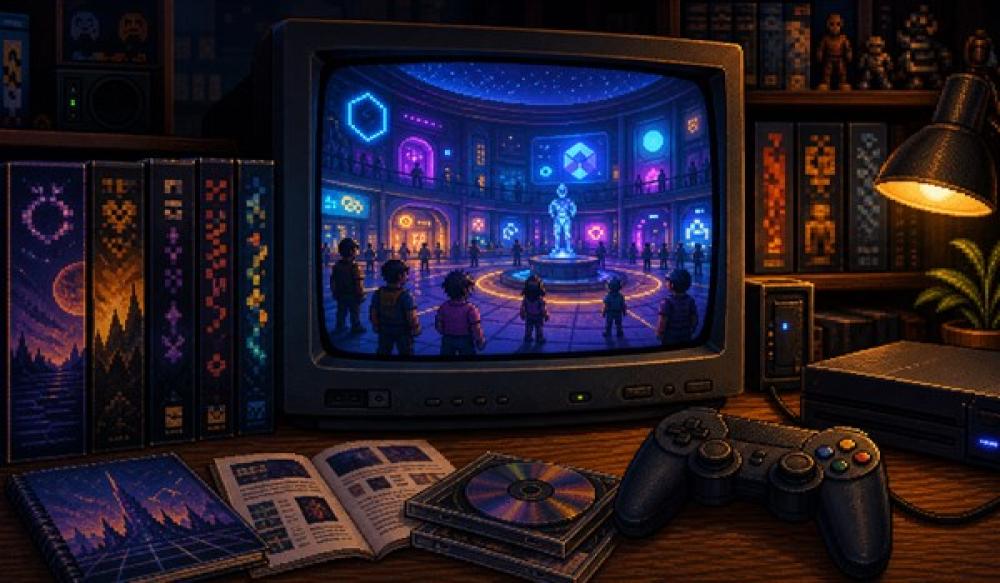

(Illustration: GamingPlanet.nl)
Sony opens the PlayStation Home beta to PlayStation 3 players today. Not as a normal app, but as a virtual place where the PS3 suddenly tries to become a small online square.
PlayStation Home is available from 11 December through the PlayStation Network column of the XMB. Anyone with a PS3, a PSN account and broadband internet can download the service for free. From there you create an avatar, walk through public spaces, talk to other players and visit areas built by Sony and its partners for the service.
That may sound simple, but the idea feels large. Sony does not only want to make a menu from which you launch games. It wants to build a kind of digital hall around the console: a place for trailers, mini-games, events, clubs, custom avatars and personal spaces. As if the PS3 does not merely sit under the television, but has its own small district behind the screen.
For many people, the first visit to PlayStation Home will mainly be curiosity. What does my avatar look like? What happens if I speak to someone? Why am I standing with dozens of strangers near a virtual bowling alley? And how many people will try the same dance animation within ten minutes?
That last point is a little silly, but it also matters. An online service does not live only through features. It lives through awkward moments, strange habits and people testing how far the system bends. PlayStation Home has to prove that it is more than a nicely decorated chat channel.
The basics are clear, at least. Users can communicate through text and voice chat, form clubs, customize a personal space and walk through themed areas. In Japan, Sony mentions launch content around Namco Museum, SIREN and Everybody's Golf. That immediately shows the intended direction: not separate from games, but wrapped around them.
In 2008, online console gaming is still trying to find its shape. Xbox Live has a clear lead in structure and ease of use. Nintendo is doing its own peculiar things with avatars and channels on the Wii. With PlayStation Home, Sony is trying something else: not only a friends list, but a space.
That fits the PS3. From the start, the console has felt as though it wants to be more than a games machine. Blu-ray player, media box, online platform, technical showpiece. PlayStation Home is almost the most visible expression of that: ambitious, glossy, sometimes a little awkward, but clearly intended as something bigger than a simple extra option in the menu.
Kazuo Hirai describes the service in Sony's announcement as a promising network community for the PlayStation platform. That is tidy corporate language, but behind it is an interesting bet. If players are online anyway, why should they only meet inside matches or messages? Why not create a central place where brands, games and players walk through one another?
It is easy to be sceptical. A virtual apartment can quickly sound like a gimmick. Buying clothes for an avatar will not appeal to everyone. And if spaces load slowly, the feeling of a busy world can disappear into a progress bar very quickly.
Even so, PlayStation Home is exactly the kind of experiment that becomes interesting later. It sits somewhere between a chat room, an MMO town, an advertising plaza and a console dashboard. It tries to create social presence before almost every major platform has found its own language for that. You could say that Sony is opening a small future today that does not quite know how to walk yet.
That makes it more interesting for gaming history than a normal service update. Not everything has to be perfect immediately to become important. Sometimes a strange idea is valuable because it shows where a company thought the world was heading.
There is also a preservation angle here. A game on disc can be kept, even if that sometimes takes work too. An online world like PlayStation Home is more fragile. Its value is not only in files, but in public spaces, temporary events, user behaviour, purchased items, server logic and shared memories.
That may not feel urgent today. The service has just opened, the paint is still wet, and most players will simply want to look around. But projects like this can easily slip through the cracks of gaming history later. Everyone remembers that they existed, but almost nobody can experience them as they were.
For now, PlayStation Home is mostly a curious step from Sony. Perhaps it becomes a busy social centre. Perhaps it remains a handsome lobby that players occasionally walk through before launching a normal game after all.
Either way, the PS3 gained a new front door today. Behind it waits a strange, ambitious little piece of 2008.
Tags: News, Sony, PlayStation, Retro gaming, Preservation