
(Illustration: GamingPlanet.nl)
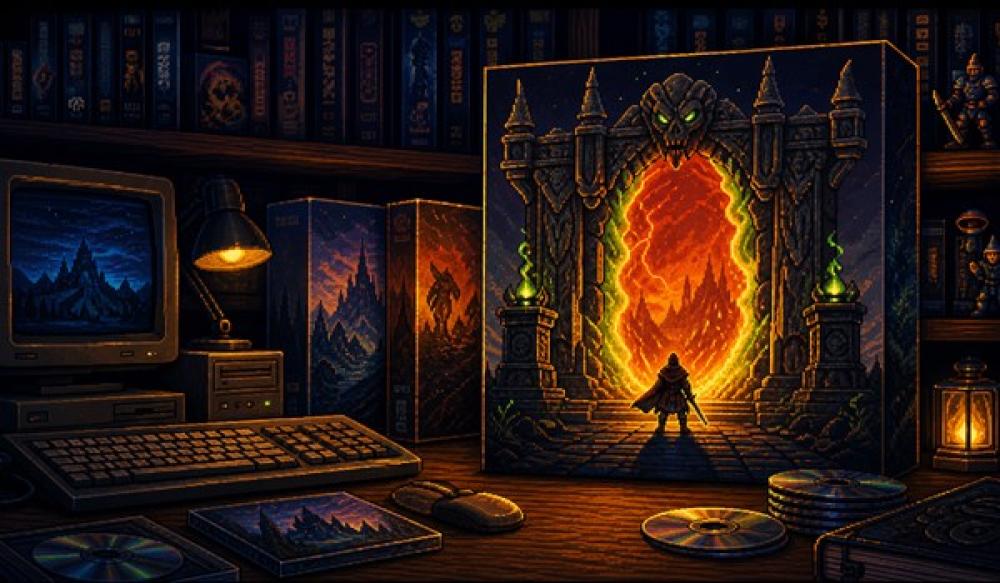
On 16 January 2007, the Dark Portal opened. Not only into Outland, but into a new idea of what an online game could be.
An expansion for an online game sounds almost ordinary today. A new area appears, the level cap rises and some of the equipment players worked for over many months is replaced. Then the cycle starts again. In 2007, that did not yet feel like a fixed pattern. To many players, World of Warcraft was not a game to be exchanged every few years, but a place they had been learning to navigate since 2004.
The Burning Crusade changed that. The expansion added Outland, two new playable races, flying mounts, Arenas, Jewelcrafting and a new endgame. Its most important change, however, was not printed on the back of the box. Blizzard showed that a living online world did not have to end before it could begin again. The existing world could remain in place while almost all attention moved towards a new chapter.
The first journey through the Dark Portal was therefore more than a loading screen between two areas. Players who had spent years spreading out across Molten Core, battlegrounds, gathering routes and quiet corners of Azeroth suddenly stood in almost the same place again. On the other side waited Hellfire Peninsula: red, broken, filled with demons and, during the first days, mostly filled with other players.
That shared starting point made the launch special. Everyone had to discover which quests mattered, where a dungeon entrance was hidden and why a strange green item could suddenly outperform an epic reward earned through months of work. The expansion temporarily turned experienced players back into beginners. Not because their knowledge had become worthless, but because the rules, routes and priorities had to be learned again.
Demand was enormous. According to Blizzard, The Burning Crusade sold nearly 2.4 million copies during its first 24 hours and approximately 3.5 million during its first month. Those figures do not explain how the expansion played, but they do show how many people wanted to step through the same portal at once.
Outland consisted of seven main zones and was not larger on a map than everything already available in Azeroth. It nevertheless felt different. Hellfire Peninsula floated like a broken piece of land in space. Zangarmarsh was blue, wet and alien. Nagrand offered open grasslands, while Netherstorm appeared to consist almost entirely of separated islands and purple energy. The zones were visually connected, but each had a strong identity of its own.
Shattrath City also changed the social layout of the game. For the first time, Alliance and Horde shared one important neutral centre in the new world. Players from both factions stood beside each other at banks, portals and quest givers without making the old conflict disappear. The choice between the Aldor and the Scryers added another layer: even inside the same city, players could follow different rewards, recipes and routes.
Outland was also more densely organised than many older zones. Dungeons were placed in recognisable groups, reputations led towards specific rewards and almost every area pointed towards another activity. The result was sometimes clear and sometimes exhausting, but rarely empty.
The Blood Elves for the Horde and the Draenei for the Alliance quickly became two of the expansion's most recognisable additions. Their starting zones were more colourful and tightly structured than many original areas, but their greatest effect came from class distribution. The Horde received paladins and the Alliance received shamans.
That may now sound like an obvious balance change, but at the time it affected the identity of both factions. Paladins and shamans were not merely different classes; they also shaped group compositions, buffs and the way players talked about the Alliance and Horde. The Burning Crusade made the factions slightly more equal mechanically, while the new races made their visual and narrative differences even larger.
Flying mounts were perhaps the clearest symbol of the expansion. At level 70, a player could take off, cross mountains and view zones from an angle that had previously seemed reserved for developers. For the first time, the world was not defined solely by roads, bridges and carefully placed mountain passes.
That freedom also came at a cost. A landscape that felt large and dangerous from the ground could be reduced from the air to the shortest line between two points. Players could avoid fights, land directly behind a quest objective and leave again. Flying made Outland more impressive, but it also started a discussion that would return with later expansions: how much freedom can players receive before the world itself loses meaning?
The endgame changed just as strongly. The original version of World of Warcraft was known for forty-player raids. The Burning Crusade turned Karazhan into a ten-player raid and reduced the main larger raids to twenty-five players. Organisation was still difficult, but it became more achievable for a wider range of guilds.
At the same time, the road towards those raids was long. Heroic dungeons, reputation requirements, attunement quests and interconnected quest lines turned progression into a shared project. A guild did not only need capable players; it needed people who had collected roughly the same keys, reputations and forms of access at roughly the same time.
For some, that was exactly the attraction. A raid did not begin at its entrance, but weeks earlier in dungeons, forum discussions and conversations about what each player still had to complete. For others, it felt like administration disguised as adventure. Both experiences belong to the memory of The Burning Crusade.
The expansion gave players more ways to stay occupied after reaching level 70. Arenas turned competitive battles between teams of two, three or five players into a system of their own. Heroic dungeons offered more difficult versions of familiar instances. Reputations, badges, professions and later daily quests ensured that almost every evening presented a list of possible goals.
In doing so, The Burning Crusade established many foundations of the modern MMO endgame. There was always another upgrade, reputation level, attunement, Arena rating or raid ahead. That provided direction, but it could also turn play into maintenance. The world was not only waiting to be explored; it asked players to return continuously.
The physical release of The Burning Crusade looks excellent in a collection. Its box, manual, discs and advertisements preserve a moment when an expansion was still presented as a major PC product in shops. As we wrote previously in Why physical PC games are still worth owning, such a release tells us far more than which files had to be installed.
That box could never preserve the original experience by itself. The code on the discs required Blizzard's servers, an account and an active subscription. As patches appeared, classes, quests, items and zones changed. The version players entered in January 2007 no longer existed in exactly the same form only a few months later.
This makes online games difficult to preserve. Screenshots, videos, box contents and patch notes can be archived, but a living world also consists of players being present at the same time, a server economy and the unwritten knowledge of a community. Blizzard partly returned to this period with Burning Crusade Classic in 2021, but even an official re-release cannot fully restore the uncertainty, hardware, internet culture and social relationships of 2007.
This is also why the history of WoW emulation is more than a technical side story. It demonstrates how far players will go when an online world can still be remembered but can no longer be visited directly. Game preservation may begin with a box on a shelf, but for an MMO it never ends there.
The Burning Crusade is often remembered for Illidan, Karazhan, Blood Elves, Nagrand and the first flight above Outland. Its larger legacy is less visible. The expansion made it clear that World of Warcraft would not remain one completed world, but would become a series of worlds built on top of each other. Every new chapter could become larger, more accessible and more spectacular while the previous one slowly turned into history.
That was exciting and sometimes painful. Players received new places to discover, but also learned that nothing in an online world truly remains still. Equipment becomes obsolete, meeting places empty and even familiar rules can disappear. What remains are the stories of the people who were there, together with the fragments preserved carefully enough to survive.
The Dark Portal therefore opened more than the road to Outland. It opened the road towards the World of Warcraft we know today: a game that continues to exist by constantly leaving part of its earlier form behind.
Tags: World of Warcraft, Blizzard, PC, MMORPG, Retro gaming, RPG