

Sony
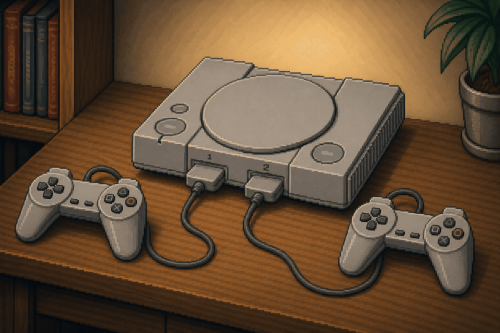
With the first PlayStation, Sony suddenly moved into the centre of console culture in the 1990s, bringing cd-roms, memory cards, recognisable controllers and a machine that spoke to a broad new audience.
Here you will find stories about Sony hardware, PlayStation generations, physical discs, downloads and the question of what remains of a game when servers, stores or licences begin to shift.
This page brings together the main Sony pages, with the first PlayStation as the natural place to begin.
The history of Sony as a console brand begins later than the history of Nintendo and SEGA, yet that does not make it any less decisive. Where some other brands built their names slowly across multiple hardware generations, Sony arrived in the 1990s with unusual force. The first PlayStation did not feel like a cautious experiment. It felt like a machine that immediately claimed a place in the living room.
That is exactly why Sony works so well as a historical subject. The rise of the PlayStation does not only explain one successful console, but also a wider shift in game culture. CD-ROMs, memory cards, 3D games, demo discs, a broader music-and-media atmosphere and a different picture of the audience all came together here. Sony was not only selling hardware, but also a new idea of what a console could look and feel like.
The first PlayStation also arrived at a moment when the market was open enough for a new tone. The console connected with players moving over from PC gaming, arcades, Nintendo or SEGA, yet still projected a character of its own. The grey shell, the controller, the jewel cases and the way games were presented gave Sony a recognisable identity very quickly. For many players, that identity is tied to a very specific domestic picture as well: stacks of cases, loose memory cards, a startup sound and a television suddenly full of 3D spaces.
From there, the line kept growing. The PlayStation 2 widened the audience even further, the PlayStation 3 introduced a heavier online and account layer, and later generations made downloads, patches and digital storefronts steadily more important. Because of that, the history of Sony is not only a story about consoles, but also a story about changing ownership. What felt like a clear physical purchase in the first PlayStation era later became more and more tightly bound to accounts, servers and licences.
That is exactly why Sony is so useful for bigger preservation questions. With PlayStation, you can almost watch the industry move from tangible discs toward dependent digital ecosystems in miniature. Jewel cases, demo discs, memory cards and regional editions belong to the older physical story, while store closures, vanished downloads and reliance on platform services show how unstable modern ownership can become.
That does not mean the physical layer disappears from Sony history. In fact, the growing digital layer makes the tangible remains of earlier generations more interesting. An original PlayStation release still tells you something about packaging, manuals, disc design, region, branding and use context. All of that goes beyond the software itself and shows why collecting and preservation mean more than simply having a working image or a folder of install files.
The PlayStation line connects iconic hardware, broadly known games and modern debates about ownership, access and long-term preservation. That combination is what makes Sony historically powerful: it is a brand that triggers nostalgia while exposing very current problems.
PlayStation quickly became a brand where platform games, racers, horror, RPGs, demo culture and later online services all found a place. That makes Sony history a story about changing play styles as much as changing hardware.
With Sony, physical ownership often rubs directly against digital access. Discs, downloads, store accounts and vanishing licences all exist side by side here, which makes PlayStation especially useful for questions about ownership and preservation.
PlayStation is one of the clearest places to see how modern ownership can become unstable. Downloaded titles, store closures and server dependency reveal the difference between having bought something and having lasting access to it.
These broader routes keep the main body of the page compact while still giving you clear entry points into related topics.
 ,
,
 ,
,
 ,
,

Copyright © 2008-2026, GamingPlanet.nl