

Sony article
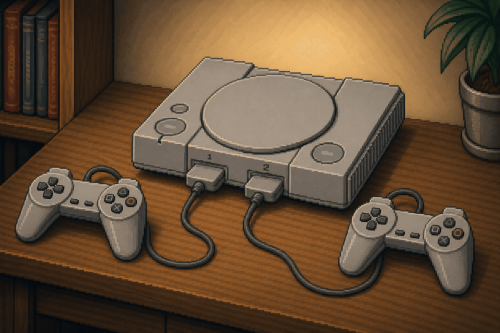
When the first PlayStation launched in Japan on 3 December 1994, Sony was not yet an established console giant. Even so, that machine reshaped the field with surprising speed.
This dossier looks at the original PlayStation, the move to cd-roms, memory cards, the standard controller and the way Sony quickly grew from newcomer into a central console brand.
The first PlayStation was Sony's major entrance into the console market. The machine combined a recognisable grey design with cd-roms, separate memory cards and a controller that would become familiar to an entire generation of players.
That made PlayStation more than new hardware alone. It also brought a different console mood with it: more discs, more 3D, more visible marketing and a broader audience than many earlier systems had managed to reach.
Sony was not first to make a console, but it did arrive at exactly the moment when 3D graphics, disc-based storage and a broader pop-cultural image came together. That made the PlayStation feel immediately different from many of its predecessors.
The shape of the system mattered too. Console, controller and memory card became recognisable household objects rather than only technical parts of a game machine.
The first PlayStation belongs to a different collecting world than cartridge systems. Jewel cases, demo discs, multi-disc releases, region variants and separate memory cards give the platform a very distinct physical identity.
That is essential for preservation. A PlayStation game is not only the disc, but also the memory card save, the manual, the cover and sometimes the question of whether a particular edition is still readable or complete.
The original PlayStation was more than a commercial success. It was the point at which Sony showed that a new brand could move into the centre of console history quickly and help reshape it.
Looking back at the first PlayStation therefore also means looking at the rise of demo culture, broader audiences, new marketing styles and a generation of games strongly tied to the cd-rom era.
The original PlayStation is the starting point of Sony as a console brand. This is where the line began that later grew into PS2, PSP, PS3 and digital PlayStation services.
Following the first PlayStation naturally leads into memory cards, downloads, vanished licences, physical discs and wider questions about what game ownership really means over time.
 ,
,
 ,
,
 ,
,

Copyright © 2008-2026, GamingPlanet.nl