

Atari
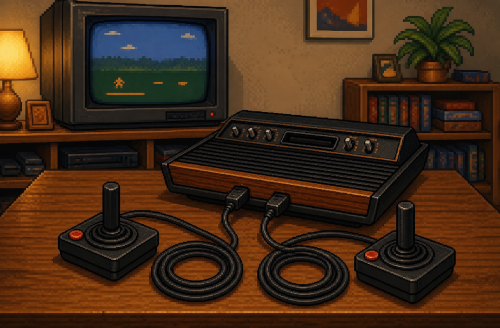
Long before downloads, accounts and patches became routine, Atari helped define what home gaming could look like: a console under the television, a joystick in your hand and cartridges moving between shelf and living room.
Here you will find stories about Atari hardware, cartridges, joysticks, collecting and why early console history still matters for game preservation.
This page brings together the main Atari pages, with Pong and the Atari 2600 as its clearest early anchors.
The history of Atari begins in a period when video games were not yet naturally associated with the living room. When Atari was founded in 1972 by Nolan Bushnell and Ted Dabney, the medium was still tied much more closely to arcades, experimentation and the simple wonder of an interactive screen. That is exactly why Atari now feels less like just another old brand and more like one of the early anchors of the entire industry.
With Pong, Atari almost immediately gained a public identity that went beyond a single machine. The game was simple, but its impact was large: suddenly it became clear that video games did not have to remain a technical curiosity, but could become a recognisable commercial and cultural product. In those early years, Atari therefore stood not only for hardware, but for the idea that electronic play could claim its own place in everyday life.
By the middle of the 1970s, that story was shifting more clearly from the arcade into the home. The move toward the Video Computer System line, later best known as the Atari 2600, made Atari one of the brands that truly carried video games into domestic space. That was not just a technical transition. It also changed how games were bought, kept, shared and remembered. The cartridge became a physical object on the shelf, the joystick sat on the table, and the console became part of the furniture of the room.
That is why Atari remains historically so important. Many later systems became more powerful, more polished or more complex, but Atari shows very clearly where much of the foundation came from. Not only the hardware itself, but also the ritual around it: swapping cartridges, keeping boxes, reading manuals, watching controllers wear down and giving the console a permanent place beneath the television. It sounds ordinary now, yet a large part of console history lives exactly there.
The Atari 2600 eventually became larger than its own library. The machine turned into a cultural image of early video games, even for people who never owned one themselves. Because of that, Atari works not only as a brand, but as an entry point into the first phase in which home consoles became widely recognisable. The line toward later systems, collectors and preservation questions begins here unusually early and unusually clearly.
With systems this early, it becomes very obvious how much context disappears if only the software remains. A loose ROM says less than a cartridge with label variations, a box, a manual, a joystick and an understanding of how the system was actually connected and used. Atari makes it clear that preservation is not only about data, but also about form, materials and the lived environment of the machine.
Atari connects early arcade history, the first real years of home consoles and the tangible side of collecting. The brand is not only old or nostalgic. It also shows how video games first began to occupy a stable place in the living room.
Early console history shows how fragile context can be. A loose ROM tells far less than a full story that includes the cartridge, box, manual, hardware revisions and an understanding of how the system actually lived in someone's home.
An Atari collection is more than a stack of cartridges. Boxes, regional editions, manuals, controllers and signs of use all help explain how a game was once sold and played.
These routes keep the main page compact while still giving direct access to related articles and broader themes.
 ,
,
 ,
,
 ,
,

Copyright © 2008-2026, GamingPlanet.nl