

Atari article
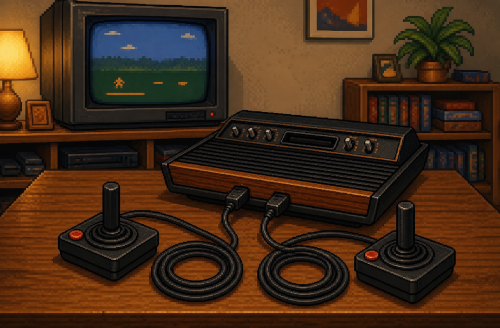
The Atari 2600 was not the first home console ever made, but it is one of the machines that fixed the image of home gaming in place: a console under the television, a joystick on the table and swappable cartridges that made a small home library possible.
This dossier explains why the Atari 2600 remained so recognisable, what makes the system historically important and why a complete example still tells more today than the bits on the cartridge alone.
The Atari 2600 originally launched in 1977 as the Atari Video Computer System, later becoming best known as the Atari 2600.
The system helped make cartridge-based gaming a mainstream living-room idea. Not because it was literally first with the concept, but because the model of multiple games on one recognisable console became visible and understandable to a broad audience.
Part of the 2600's strength was its simplicity. The idea made sense immediately: one console, multiple cartridges, recognisable controllers and a television that could now do more than show one fixed built-in game.
That made the 2600 more than a piece of hardware. For many people it became a pattern, and later memories of early video games often still point back to this exact kind of living-room setup.
For collecting and game history, an Atari release is rarely just the cartridge. Box, manual, regional edition, label differences and signs of use all help define what a specific release actually was.
That is also why a working dump or loose ROM can be useful but never preserves the whole story. The context around the game belongs to the object too.
Older hardware can make preservation look simple at first: keep the cartridge and you are done. In reality, that is where the work begins. Which revision is this? Does this manual belong with it? Is the joystick original? Which box variant was normal in that region?
The Atari 2600 makes it very clear that preservation is not only about playability. It is also about documentation, provenance and honestly recording what is original, replaced or incomplete.
Following the 2600 outward quickly shows how home consoles, accessory culture and physical media later developed further across other brands.
These routes fit naturally with the Atari 2600, especially where availability, archives and the preservation of physical context are concerned.
 ,
,
 ,
,
 ,
,

Copyright © 2008-2026, GamingPlanet.nl