

PC
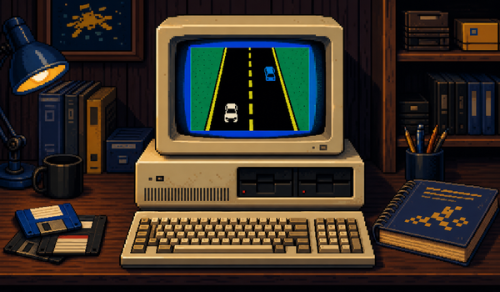
The PC is not one single machine, but a long line of hardware, DOS disks, Windows versions, sound cards, video cards, big boxes and games that are often as technically interesting as they are culturally important.
Here you will find in-depth articles about the history of PC gaming, the technology behind it, physical releases and the preservation of older games.
Here the main PC pages are gathered in one place, from early DOS history to broader dossiers on collecting, big boxes and modern RPGs.
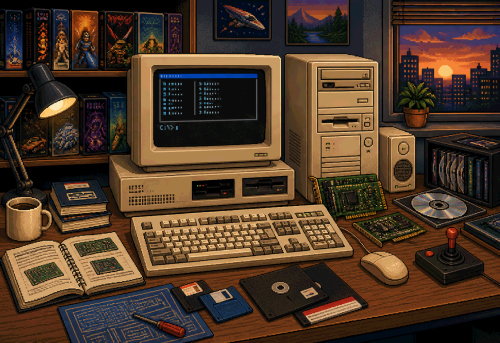
The history of the PC is hard to divide into neat generations. With consoles, you can usually point more clearly to where one era begins and another ends, but on the PC different time layers keep sliding over each other. A DOS game from the 1980s, a point-and-click adventure on CD-ROM from the 1990s and a modern Steam download all belong to the same platform, even though the practical experience around them can feel completely different.
The early IBM PC and its compatibles were also not automatically seen as game machines. Even so, that was where many of the lines that would define PC gaming began to form: expandability, interchangeable parts, different video cards, different sound solutions and a user who sometimes had to work out for themselves why something did or did not work. That gave PC gaming its stubborn character very early on. It was less "insert cartridge and press start" and more a mix of curiosity, manuals, configuration and patience.
In the DOS years, that kind of fiddling almost came with the territory. Memory management, sound settings and competing graphics standards all helped shape how a game was experienced. For one player, a PC game was a modest EGA or VGA release on floppy disk; for another, it was a deluxe CD-ROM edition with speech, extra music and a thick paper manual. That difference in editions still forms a large part of the platform's charm: PC history lives not only in the software itself, but also in the many small technical and physical variations around it.
From the 1990s onward, the PC increasingly became a place where genres could broaden or properly settle in. Strategy, simulation, management games, adventures, online role-playing and later moddable shooters and open worlds all found extra room on PC. Keyboard and mouse were part of that story, but so was the openness of the platform itself. Players could keep files, install patches, add expansions, copy savegames and keep tinkering with the same game for years.
That openness came with a clear downside. Precisely because a PC is not one fixed box with the same components in every home, the context around games ages quickly. Operating systems change, drivers disappear, copy protection falls out of use and online layers become more important. An old cartridge-based console can sometimes still boot surprisingly directly after decades; an old PC game more often demands knowledge of its original environment. That is why preservation on PC nearly always goes hand in hand with documentation: which edition it was, which patch worked and which hardware or tool was needed?
That makes the PC both messy and rich. The platform has no single pure starting point and no perfectly straight line, but that is exactly what makes it so interesting. The history of PC gaming is made up of beige cases, oversized boxes, shareware, LAN evenings, drivers on floppy disk, CD-ROM folders, download accounts, mods, fan patches and players who kept things running long after a manufacturer had moved on. To understand the PC, it is not enough to look only at famous games. You also have to look at installers, manuals, sound cards, save files and the culture of figuring things out for yourself.
Older PC games often depend on manuals, installation codes, patches, drivers and information about the original hardware. Without that context, a complete game can still become difficult to play or even understand.
DOSBox, ScummVM, virtual machines and compatibility layers can make old games playable again. It remains important to distinguish the original files from the modified working copy.
These routes bring related subjects together and make it easier to keep reading within the PC knowledge base.
 ,
,
 ,
,
 ,
,

Copyright © 2008-2026, GamingPlanet.nl