
(Illustration: GamingPlanet.nl)
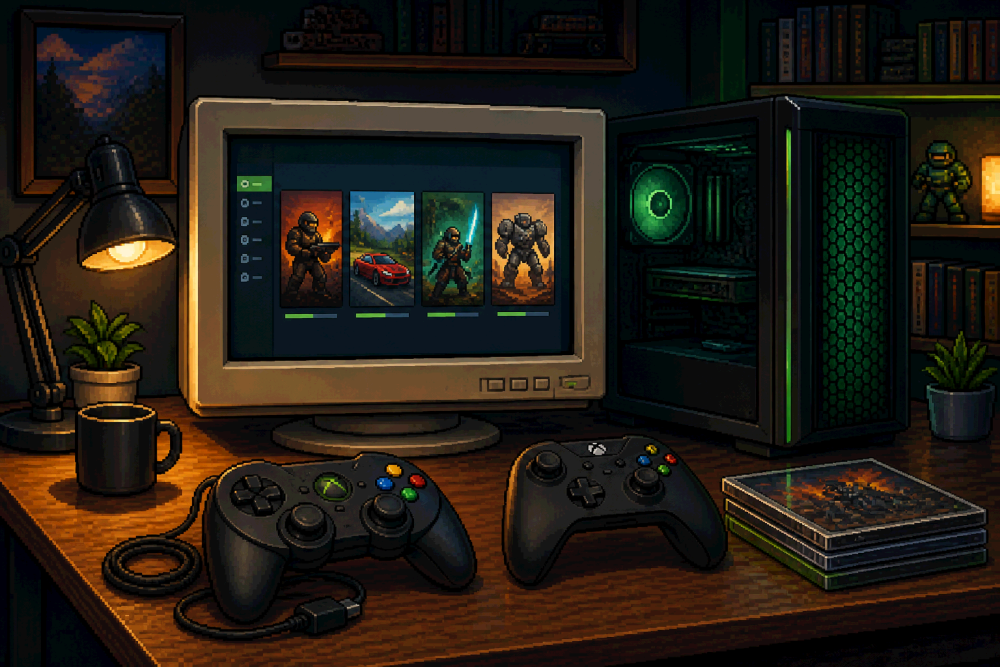
Microsoft announced one of the nicest surprises of the year on July 22, 2026: Xbox backward compatibility is coming to PC. Not as a vague nostalgic label or a loose remake, but as a system where part of the older Xbox catalogue can move to desktop and handheld with improvements and existing digital rights intact.
The first step is still modest. The early release covers four original Xbox games: BLiNX: The Time Sweeper, Conker: Live and Reloaded, Crimson Skies: High Road to Revenge and Fuzion Frenzy. Even so, the direction already feels larger than the list. For the first time in a while, a major platform holder is openly saying that an older console game does not have to remain locked to its original hardware when the rights and technology can still be carried forward cleanly.
Microsoft is not framing this as a dusty retro corner of the store, but as a practical extension of the current Xbox ecosystem. If you already own a supported game digitally on console, you will not have to buy it again to play it on PC or handheld. That detail alone turns this from a cute archive feature into a serious signal about digital game ownership.
For players, that means something simple: a purchase becomes less dependent on one piece of hardware. For collectors and preservation-minded players, it means something bigger. A game that used to be trapped inside an older console library suddenly gets a second life in an environment that is easier to preserve, document and reuse.
Microsoft is also explicitly promising PC-specific options such as graphics settings, windowed and fullscreen modes, VSync, anti-aliasing, anisotropic filtering and up to four times the original resolution. So this is not just transport. It is also a form of care.
Backward compatibility is often discussed as if it were mainly a technical problem. Emulation, wrappers, rendering layers, controller support. All true. The real blockade usually sits somewhere else, though: in licences, store structures and whether a platform holder is still willing to treat an older purchase as your purchase once the platform changes.
That is exactly where this news becomes unusually strong. Microsoft is not only connecting software to new hardware here, but rights to a new place. That is rare. Many digital stores would rather treat an older product as something that can be sold again the moment the hardware context changes. Xbox is making the opposite gesture.
That is also why the story fits GamingPlanet so well. We have spent plenty of time writing about discs, boxed games, second-hand markets and what a purchased game is really worth once it survives only as an account rule. Seen through that lens, this step feels almost refreshingly old-fashioned: a company acknowledging that earlier purchases do not automatically need to be charged again.
Of course, this does not solve everything. Four games are not a full library. Many older titles are still tangled up in expired music rights, publishers, middleware or contracts written long before anyone imagined PC handhelds. Players also remain dependent on a platform holder deciding which titles are allowed to move and which ones stay behind.
Even so, it is hard to be cynical about this. Every step that makes older games usable outside their shrinking original context is a win. That goes double when it happens without flattening history into nothing but remasters and subscription filler. An original game moved forward with respect, existing rights included, says more about preservation than yet another polished reissue.
That is why this matters. Not because it solves the whole problem, but because it does something concrete. It pulls a few old games out of a narrower technical and commercial cage. Sometimes preservation begins with exactly that kind of small door finally opening.
Microsoft also says achievements for selected original Xbox games on console and PC will follow later this year. That may sound like a side note for achievement hunters, but it really shows something else: the older catalogue is not being treated as a museum object. It is being threaded back into a living platform.
That is exactly why the story belongs inside game preservation. Preservation is not only about boxes on a shelf or a disc image on a server. It is also about whether older games can remain credibly playable, reachable and meaningful inside the present-day landscape.
If Microsoft keeps pulling on this thread, we may finally get a model where older console games are not only remembered, but allowed to keep moving with the way people actually play now. And honestly, that is much more interesting than hearing yet another company say the cloud will sort it all out eventually.
Source: Xbox Wire, July 22, 2026.
Tags: News, Microsoft, Xbox, PC, Preservation, Game ownership
 ,
,
 ,
,
 ,
,

Copyright © 2008-2026, GamingPlanet.nl