

Nintendo
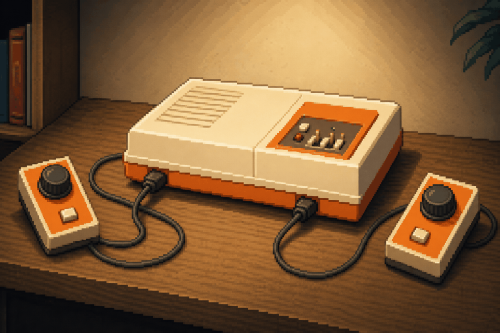
Nintendo history runs from the early Color TV-Game systems to the Famicom, Game Boy, Nintendo DS and Switch, with cartridges, optical discs, game cards and shifting ideas about where and how people play along the way.
Here you will find stories about Nintendo hardware, games, physical releases, collecting and the question of how older Nintendo systems and games can be preserved.
This page brings together the main Nintendo pages, from the Color TV-Game to the Famicom and Game Boy.
The history of Nintendo is older and broader than many players first assume. For a lot of people, the story begins with the NES or perhaps the Game Boy, but the brand had already moved through toys, experiments and the Color TV-Game systems before it reached that point. Because of that, Nintendo history feels less like one straight product line and more like a series of shifting ideas about how people play at home, on the move and together.
That is exactly what makes Nintendo so interesting as a historical brand. Where some other brands read more cleanly as hardware history, Nintendo almost always ties the shape of play directly to the machine. The Color TV-Game, Famicom, Super Nintendo, Nintendo 64, GameCube, Wii and Switch all belong to the same brand name, yet they do not all begin from the same idea. Sometimes the focus is technical power, sometimes accessibility, sometimes family use, sometimes portability and sometimes a completely different way of controlling the game.
That begins in the early home period. The Color TV-Game line from 1977 shows a version of Nintendo still far removed from the later world of mascots and cartridge empires. Even so, that phase matters because it shows Nintendo already trying to understand how a game device should fit into the home. Not as abstract technology, but as something placed in the living room, immediately understandable and built around shared use.
With the Famicom, the scale of the story changed completely. From that moment onward, Nintendo was not only making game machines, but increasingly shaping the rules of the living room itself. Cartridges, familiar controllers, clear system identities and a library of recurring series helped turn Nintendo into a brand that felt almost inevitable in many households. In Europe and North America that memory often survives through the NES, but the core shift is the same: Nintendo became a central console manufacturer.
After that, the brand did not sit still. The Super Nintendo refined what came before it, while the Nintendo 64 opened a different phase built around 3D, analogue control and local multiplayer. The GameCube now feels more compact and idiosyncratic in hindsight, while the Wii showed that Nintendo was sometimes willing to step away from the technical arms race in order to reopen the question of who games were for.
Just as important is the fact that Nintendo has never been only a home-console story. Game & Watch, Game Boy, Nintendo DS and Nintendo 3DS formed a second major line of their own, one in which battery life, screens, portability, link cables, cartridges and later stylus and dual-screen play created a separate history. The Switch eventually brought those traditions closer together again, and that only makes it clearer how long Nintendo had already been moving back and forth between the living room and life on the move.
For game preservation, Nintendo is therefore rich material. Not only because there are so many famous systems and games, but because context matters so much here. Cardboard boxes, manuals, regional editions, different cartridge revisions, save batteries, handheld screens and specific controllers all preserve something that disappears when only a dump or a rerelease survives. With Nintendo, a large part of the history lives in the physical and social way the game was originally experienced.
Nintendo is playful, historically important and highly collectible at the same time. The brand ties together early living-room systems, portable classics, iconic series and modern debates about access and preservation. Because of that, Nintendo is not only a name attached to famous characters, but also a long history of hardware choices that kept reshaping what play could feel like.
From Mario and Zelda to Metroid, Pokémon and smaller experiments, Nintendo platforms are tied to series that return across generations while constantly changing shape.
A Nintendo collection can include cardboard boxes, plastic cases, cartridges, discs, game cards, manuals, inserts and accessories that differ sharply by region.
Older Nintendo games sometimes return through rereleases, remasters or subscription services, but modern access is not automatically the same thing as preserving the original hardware, packaging, save data and play context.
These broader routes keep the main body of the page compact while still giving you clear entry points into related topics.
 ,
,
 ,
,
 ,
,

Copyright © 2008-2026, GamingPlanet.nl