

Nintendo article
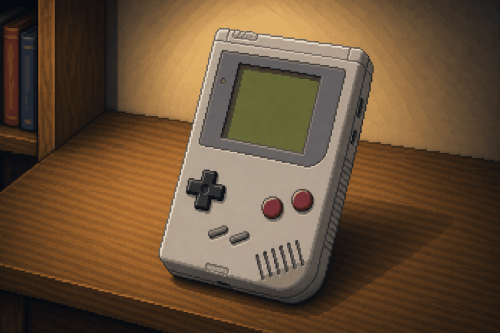
When the Game Boy launched in Japan on 21 April 1989, Nintendo showed that portable gaming did not have to be small in ambition or short-lived. It could be a full platform in its own right.
This dossier looks at the first Game Boy, the monochrome screen, cartridges, its broad audience and the reasons this handheld stayed relevant for so long.
The original Game Boy made handheld gaming feel ordinary and durable. Where earlier portable devices often stopped at one built-in idea, the Game Boy offered a swappable cartridge library in a form that could genuinely travel anywhere with the player.
That made it not just popular, but culturally important. The Game Boy was a machine for travel, for home, for children, for adults and for anyone who wanted a console-like experience in compact form.
The Game Boy did not need to be the most technically impressive handheld to become the most important one. Battery life, toughness, recognisable design and a growing library made it practical in a way many competitors struggled to match.
That is where its historical weight comes from. Nintendo did not build a gadget for a brief moment, but a platform that lasted long enough to teach entire generations what portable gaming could be.
With the Game Boy, portable play became something different from a shrunk-down living-room experience. The system developed its own rhythms, use cases and relationship with collecting, trading and gaming on the move.
That matters for preservation. A Game Boy cartridge, manual, battery door or linked play session says more together than the software does on its own.
Many later handhelds still live in the shadow of the first Game Boy. Not because it was the most powerful, but because it fixed the idea of portable, swappable and long-term playable gaming in a form players immediately understood.
For collectors, screen condition, battery compartment wear, labels, cartridge contacts, regional boxes and accessories matter as much as the games themselves. The physical state of a Game Boy often says a great deal about how heavily it was used.
With the Game Boy, Nintendo built a second major hardware path beside its home consoles: gaming that could travel anywhere.
Looking further from the Game Boy naturally leads into later handheld generations, physical cartridge releases and wider questions about battery preservation, documentation and digital availability.
 ,
,
 ,
,
 ,
,

Copyright © 2008-2026, GamingPlanet.nl