

Nintendo article
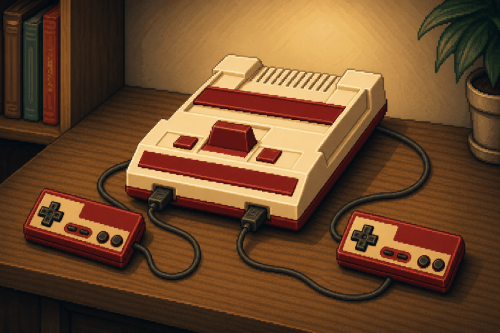
The Famicom, short for Family Computer, launched in Japan on 15 July 1983 and became the system that firmly placed Nintendo on the console map.
This dossier looks at the Japanese roots of the Famicom, the move to cartridges, its connection to the later NES and why this system became the real turning point after the Color TV-Game era.
The Famicom was not Nintendo's first home console, but it was the machine that turned the company into a major console force. Where the Color TV-Game line consisted of fixed-function systems, the Famicom offered a cartridge platform with room to keep growing.
That combination of recognisable hardware, swappable games and strong first-party titles made the Famicom the true foundation of Nintendo's later console empire.
The Famicom gave Nintendo something the Color TV-Game could not: a platform that did not stop after a handful of built-in variations, but instead expanded as more cartridges arrived.
That changed Nintendo from a maker of standalone dedicated systems into a console brand with a growing library. Historically, that may be the biggest shift between Nintendo's earlier hardware years and what followed after.
The Famicom is the Japanese base of what many players later knew as the NES. Even so, the Famicom and NES are not exactly the same story: styling, accessories and regional context differ in meaningful ways.
That matters for collectors and preservation. The Japanese Family Computer has its own identity, its own cartridges and its own place in Nintendo history beyond the later export version.
Many later Nintendo classics are difficult to imagine without the Famicom. This is where a pattern began that Nintendo would follow for years: recognisable hardware, strong mascots, clear generations and a software library that kept the system relevant.
Preserving Famicom heritage means keeping more than the games. Controllers, boxes, manuals, regional releases and the machine's place in the Japanese market all belong to the story as well.
The Famicom shows how Nintendo moved from early hardware experiments to becoming one of the defining names in home consoles.
Looking beyond the Famicom naturally leads into handheld history, regional variants, physical releases and the way Nintendo kept reinventing hardware generations.
 ,
,
 ,
,
 ,
,

Copyright © 2008-2026, GamingPlanet.nl