

Nintendo article
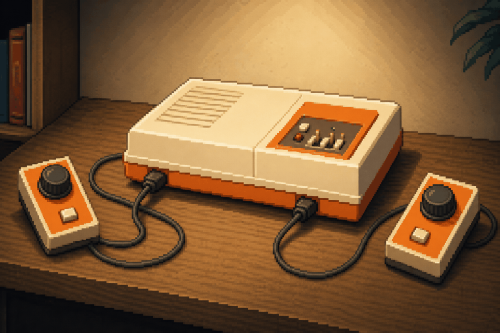
Many players begin Nintendo's console story with the Famicom or the NES. In reality, Nintendo entered the home console market much earlier with the Color TV-Game line in 1977.
This dossier explains why the TV Game 6 and TV Game 15 count as Nintendo's first home video game machines, what kind of systems they were and why they still matter for console history and preservation.
In Nintendo's own company history, the company lists the TV Game 15 and TV Game 6 as its first home video game machines in 1977. That places Nintendo's true beginning as a console maker well before the Famicom era.
The Color TV-Game systems were not cartridge machines. They were dedicated home consoles with built-in video-tennis style games. That is exactly what makes them historically useful: they belong to the dedicated-console era just before programmable systems became the standard.
The key distinction is not a hidden earlier machine, but the meaning of Nintendo's first console. If you mean the true starting point of Nintendo hardware in the living room, Nintendo itself points back to the TV Game 6 and TV Game 15 as its first home video game machines.
That matters because it pushes Nintendo's console origins back into the late 1970s, before interchangeable cartridges defined the market. The Color TV-Game line belongs to an older world of fixed hardware and a very small built-in game library.
The first Color TV-Game systems were built around simple video tennis concepts and variations on them. Compared with later Nintendo hardware they look extremely limited, but that is part of their value: they show how young the market still was.
For preservation, systems like these matter because they represent more than software history. They preserve industrial design, packaging, documentation and a period when console hardware still sat very close to toys and domestic electronics.
Anyone who only knows Nintendo through the NES, Game Boy or Switch misses an important opening chapter without the Color TV-Game. There are no major mascots or swappable cartridges here yet, but you can already see Nintendo entering the home as a videogame hardware maker.
For collectors, completeness, region variants, casing condition and original controllers matter a great deal. With very early dedicated consoles, the hardware itself is a large part of the story.
The Color TV-Game shows where Nintendo started, long before the Famicom, Super Nintendo, Game Boy or Switch made the company globally familiar.
These early Nintendo machines naturally lead to broader questions about hardware generations, physical releases, controllers and the preservation of systems older than the cartridge era.
 ,
,
 ,
,
 ,
,

Copyright © 2008-2026, GamingPlanet.nl