

SEGA
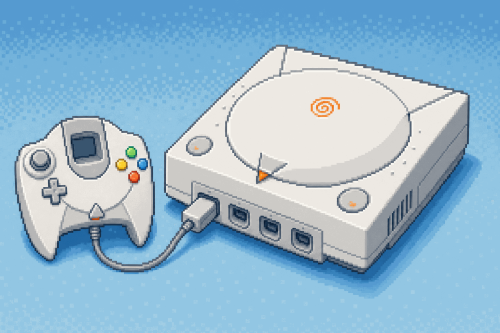
SEGA history runs from arcade machines and home consoles to handhelds, unusual add-ons, blue-spined game cases and the Dreamcast as Sega's final in-house console.
Here you will find stories about SEGA systems, hardware, cartridges, cases, regional differences and the place of machines such as the SG-1000, Master System and Dreamcast in game history.
This page brings together the main SEGA pages, from the first home console to the Master System and Game Gear.
The history of SEGA is harder to summarise neatly than the history of many other console brands. Nintendo can look, in hindsight, like a long line of clear generations, and Sony arrived later with a sharply recognisable first PlayStation. SEGA feels rougher, more restless and, because of that, more alive. The brand moved through arcades, home hardware, regional variations and technical leaps that did not always connect in a calm or logical way.
That unsettled character is exactly what makes SEGA so compelling for collectors and for anyone who does not want game history to read like a list of winners. The SG-1000, Mark III, Master System, Mega Drive, Saturn, Game Gear and Dreamcast all belong to the same brand name, but they never tell exactly the same story. Sometimes the machine is a technical catch-up attempt, sometimes a regional success, and sometimes a system that stayed culturally larger than its market share.
That story starts early. Sega did not begin as a calm console maker with a tidy master plan for the living room. The brand grew out of amusement machines and arcade spaces where immediacy, technical spectacle and visibility mattered. That arcade DNA never really disappeared. It remained visible not only in conversions and famous series, but also in the way Sega often seemed to think: faster, louder, more technical, and occasionally more risky than sensible.
When the SG-1000 arrived in 1983, Sega was still far from the image many players picture immediately today. That early system matters because it marks the real beginning of Sega as a home-console brand. From there, a line does lead toward later hardware, but not as a smooth walk. It feels more like a chain of side paths, upgrades, course changes and moments where Sega was either slightly early or slightly too committed to its own direction.
With the Master System, that line became much easier to see. For many European players especially, this is where Sega really begins as a console memory. The machine had a clearer identity, a stronger presence in shops and a library that stayed visible in some regions for a remarkably long time. That is also why the Master System feels less like a curiosity than the SG-1000 for many collectors: this is hardware still tied directly to bedrooms, cartridges, TV cabinets and childhood routines.
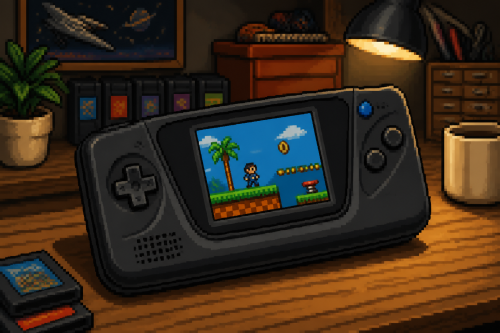
The Game Gear then shows another side of Sega. It was not simply a smaller console for use on the move, but a handheld that compressed Sega's recognisable style, strong colour and technical bravado into portable form. Because of its link to Master System-era hardware, the Game Gear feels both familiar and distinct: a branch of the same tree that still had its own personality.
After that, Sega shifted again. With the Mega Drive, the brand became sharper, faster and much more internationally recognisable. The visual style, the marketing tone and the emphasis on speed and action gave Sega a very different public face from the one it had in the SG-1000 years. This was also the moment when it became obvious that Sega was not only selling hardware, but also selling attitude. That sense of velocity and bravado is still part of how many people remember the brand.
The years that followed only made Sega more interesting as a historical subject. The Saturn is not an easy machine to reduce to one sentence: technically impressive, culturally important, yet difficult to explain outside its context of Japanese market priorities, complicated architecture and a rapidly shifting 3D landscape. The Dreamcast, by contrast, became a machine whose emotional legacy outgrew its lifespan. It is the final stop for Sega as an in-house console maker, but also a system that still feels as if it had more future left in it.
SEGA also shows very clearly how much context matters once older hardware has to be preserved or understood. Regional names, variant shells, different media formats, arcade connections, accessories and market-specific libraries make it obvious that a system is not fully explained by a ROM or a loose disc alone. The surrounding material tells you what the machine actually was.
That is why SEGA remains such an appealing historical subject. The brand ties together arcade energy, home use, physical releases and technical stubbornness in a way that still speaks strongly to collectors. Sega is not only a row of consoles. It is also a history of experiment, style, regional difference and hardware that sometimes lost, but was rarely dull.
Sonic may be the best-known SEGA character, but the wider catalogue also covers arcade racing, shooters, RPGs, experimental peripherals and series that later continued on other platforms.
A SEGA collection can include cartridges, jewel cases, larger plastic cases, cardboard sleeves, GD-ROMs, registration cards and hardware that differs by region. The same game may even have another title, cover or console name elsewhere.
Preserving a SEGA game can also require controller support, save batteries, optical-drive knowledge, network context, manuals and information about the original hardware.
These broader routes keep the main page compact while still giving you solid entry points into related topics.
 ,
,
 ,
,
 ,
,

Copyright © 2008-2026, GamingPlanet.nl