
SEGA article
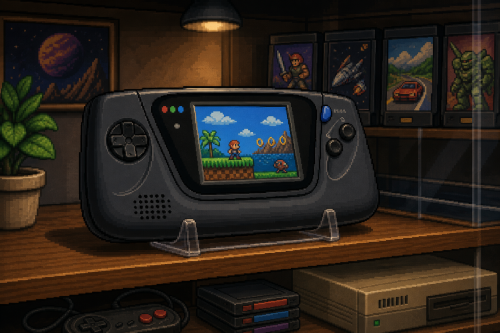
The Game Gear was Sega's colourful answer to handheld gaming in the 1990s: wider, heavier and hungrier than a Game Boy, but also bright, bold and instantly recognisable.
This dossier looks at the Game Gear as a handheld inside Sega's wider hardware line, with attention to the technology, cartridges, ties to the Master System and why the system still matters for collectors and preservation.
The Game Gear launched in Japan on 6 October 1990 as Sega's colour-screen handheld. The system shares much of its technology with the Master System, which gave it a library closely connected to Sega's home hardware.
The Game Gear became known for its colour screen and unmistakable Sega identity, but also for its large size, six AA batteries and accessories such as the TV tuner and Master Gear Converter.
The Game Gear shows clearly that SEGA did not think only in living-room terms. Where the Master System and Mega Drive were visible at home, Sega also wanted to be recognisable on the move. That made the handheld less of a side experiment and more of a natural branch of the same brand identity.
That position makes the system useful historically. The Game Gear is not only a portable game machine, but also a device that compresses Sega's style, technology and software culture into a smaller format. For many players, it belongs just as much to their Sega memory as the home consoles beneath the television.
The colour screen gave the Game Gear immediate visual appeal. At the same time, that appeal came with a cost. The system was larger than many rivals and consumed batteries in a way that still defines part of its reputation.
That is exactly what makes the Game Gear feel more human as a historical object. It is a handheld that embodies enthusiasm and compromise at the same time: technically attractive, but not efficient; forward-looking for its era, yet still clearly shaped by the limits of that period.
For collectors, the Game Gear is about more than loose cartridges. Boxes, manuals, regional editions, battery compartments, screen condition and working capacitors all matter. Portable hardware often shows wear in a different way from home consoles, and that becomes part of the record too.
For preservation, the Game Gear is also a strong reminder that software and hardware cannot be separated cleanly. A ROM tells you something about the game, but not about the colour screen, the form factor, the battery hunger, the converter accessories or the physical feel of the handheld itself.
The technical link to the Master System is what makes the Game Gear especially interesting. Anyone following Sega's hardware line can see here how home console and handheld overlap without becoming identical.
From the Game Gear, the path naturally continues into broader questions about handheld preservation, battery-sensitive hardware, screen ageing and the different ways portable systems are documented and kept working.
 ,
,
 ,
,
 ,
,

Copyright © 2008-2026, GamingPlanet.nl