
(Illustration: GamingPlanet.nl)
Games do not always disappear because nobody wants them anymore. Quite often they fade because the shop closes, the licence expires or the account model changes.
Dutch game archives are becoming more important as digital stores and online services increasingly decide what stays visible, purchasable and playable. That no longer sounds like grand cultural theory. At this point it is simply practical news. When you look at game history for long enough, you notice that preservation rarely happens on its own.
A box on a shelf can gather dust. A download disappears more quietly. Sometimes a game is pulled because of rights issues, sometimes a platform holder vanishes, sometimes a launcher no longer works the way it once did, and sometimes a purchase technically still exists while almost nobody understands which hardware or version it still belongs to.
That is why it matters that a few Dutch institutions are doing more than just collecting. They are also trying to hold on to context, playability and documentation. That is a far more useful form of game preservation than simply storing a pile of discs and hoping somebody in the future can reconstruct the rest.
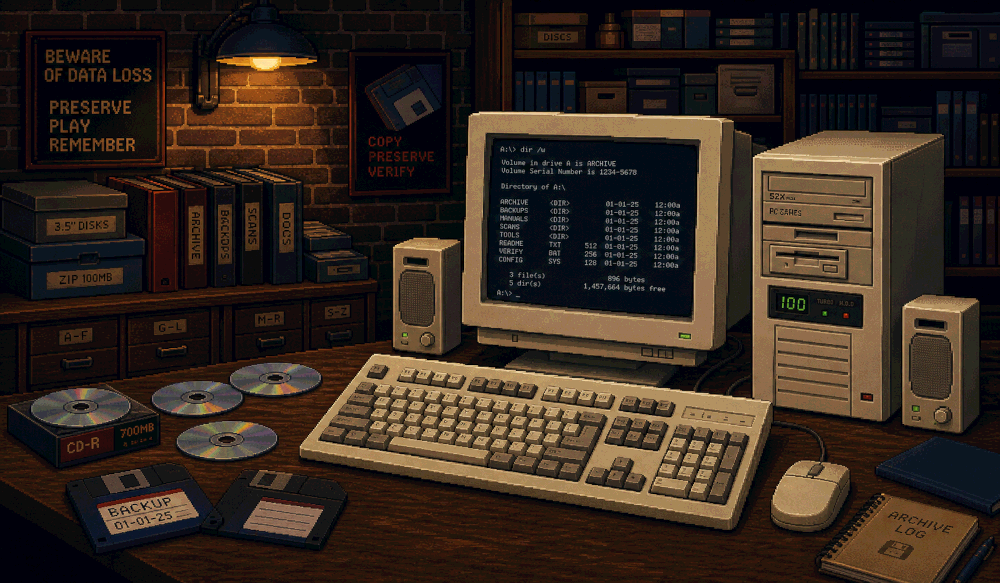
When people hear the word preservation, they still tend to think first about the carrier itself: cartridge, floppy, CD-ROM, DVD or download file. That makes sense, but it is too narrow. A game without context quickly becomes an isolated technical object. Then you lose the manual, the packaging, the version history, the installation requirements, the peripherals, the patches and the story of how a title was sold and understood in its own time.
That broader view is visible in projects such as the Dutch Games Canon by Sound & Vision. The site is not just a nostalgic list of familiar names. It works as an entry point into milestones in Dutch game history. Work like that helps because it asks not only what existed, but also why it mattered.
For players and collectors, that distinction matters. A digital storefront fundamentally preserves a sales page. An archive preserves evidence, context and meaning.
The biggest international hits are usually discussed somewhere, reissued somewhere or documented by fans. The more fragile layer sits below that: educational titles, local productions, awkward CD-ROM releases, short-lived browser projects, forgotten budget ranges and hardware-dependent editions that never became global classics.
That is a particular problem for Dutch game history. It is not made only of export successes or the best-known names. It also includes small studios, local experiments, club magazines, disc compilations and systems for which almost nobody still keeps working hardware ready to go.
HomeComputerMuseum has long shown why that matters. The museum does not only document systems, but also the software and surrounding stories that belong to them. Its own documentation around the Philips CD-i collection underlines this perfectly: the famous games are not the whole story. Lesser-known releases, demo discs and professional applications are exactly the kind of material that slips away first if nobody deliberately keeps track of them.
What makes this topic especially current is that it is no longer just about a few enthusiasts or a single museum room. Dutch institutions are also part of broader European structures. The European Federation of Game Archives, Museums and Preservation Projects, or EFGAMP, lists both Sound & Vision and HomeComputerMuseum among its members.
That matters because preservation no longer ends at the shelf or display case. EFGAMP also announced European support this summer for Games2Cloud, a project aimed at scalable access to preserved games. That may sound technical, but it goes straight to the core of the issue: an archive that cannot make anything accessible mainly preserves potential. An archive that can connect description, hardware knowledge and playability preserves experience as well.
Of course, no project solves everything. Not every title can simply be put online for the public. Rights, emulation, privacy, music licences and old server dependencies remain difficult. But the difference between doing nothing and documenting systematically is enormous. If someone records what exists today, how it worked and what it needs, the future at least has a fair chance.
That may be the bluntest lesson in the whole story. Digital stores are built to sell, update and manage. They were never designed to act as cultural memory. If a game no longer fits the rights situation, the revenue model or the technical direction of a store, disappearing is often just a business outcome.
An archive starts from the opposite question. Not: does this still sell? But: what does this say about its time, its makers, its technology and its audience?
That topic fits GamingPlanet almost suspiciously well. Anyone who has ever held an old PC big box, cartridge, demo disc or forgotten budget release already understands instinctively what archives are now making more visible. Old games are not only playable products. They are also traces of how games were made, packaged, distributed and understood.
In the end, that may be the best part of the Tweakers story. While digital stores are mostly built to move forward, there are people and institutions in the Netherlands patient enough to keep looking back. Because of that, something may still remain for future players to rediscover.
Sources: Tweakers: Dutch game archives rescue what digital stores let disappear, Sound & Vision: Dutch Games Canon, EFGAMP, HomeComputerMuseum: CD-i collection.
Tags: News, Preservation, Game ownership, Retro gaming, Hardware
 ,
,
 ,
,
 ,
,

Copyright © 2008-2026, GamingPlanet.nl