

Atari article
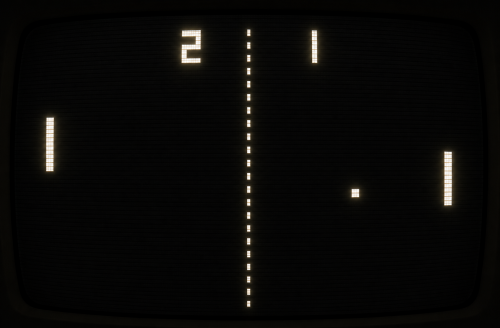
Pong was technically simple, but culturally enormous. Two paddles, a square ball and a score at the top were enough to turn a young Atari into a name people quickly remembered.
This dossier looks at the early Atari years, Allan Alcorn, the arcade context of 1972 and why Pong still returns so often whenever people talk about the public beginnings of video gaming.
Pong appeared in 1972 as an early Atari arcade game. It resembled a stripped-down table tennis match: players moved a paddle up and down to return a small white square.
That simplicity made the game approachable. You did not need a manual to understand what was happening, and inside an arcade that worked straight away in Atari's favour.
Many early games still asked the player to figure out what the screen meant. Pong barely needed that step. The whole idea was visible at once: a paddle on the left, a paddle on the right, a ball in between and a score above.
That made Pong work not only as a game, but also as a demonstration. It showed that a video game did not need to be complicated to stop people in their tracks.
Atari was founded in 1972 by Nolan Bushnell and Ted Dabney. Not long afterwards, Allan Alcorn built Pong, first as a practice project and then as a game that landed in public spaces too strongly to ignore.
That is what makes Pong historically interesting. It was not just a successful game; it was also one of the moments where Atari suddenly gained a recognisable public identity.
By later standards, Pong can seem almost too simple to write about at length. Yet that stripped-down design preserves something important: the early phase in which video games were still immediate, physical and public, often encountered in bars, arcades and other shared places.
For preservation, that means more than the playable logic alone. The cabinet, the controls, the screen, the coin-op context and the place where people first met the game all belong to the historical object as well.
Pong made Atari visible early. The step toward later home hardware, including the Atari 2600, became easier to understand after that: the brand already had a public face before it reached the living room.
Following Pong outward quickly shows how arcade history, home consoles and game preservation sit close to each other.
 ,
,
 ,
,
 ,
,

Copyright © 2008-2026, GamingPlanet.nl