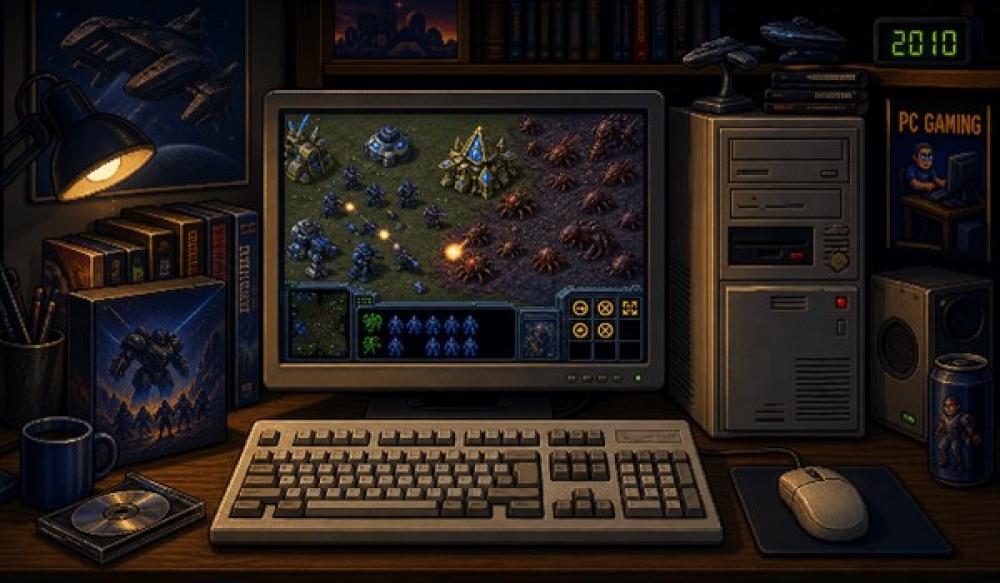

(Illustration: GamingPlanet.nl)
StarCraft II did not arrive quietly. A week after release, Blizzard reported that Wings of Liberty had already sold more than 1 million copies within 24 hours, and 1.5 million by the end of day two. For PC gaming in 2010, that was not a routine success story. It was one of those moments that made the whole market sit up straight.
The nice thing about a launch like this is that it tells two stories at once. On one level, it is simply a huge game release: a long-awaited RTS from a studio with enormous name recognition, a fanbase that had been waiting for years, and retail boxes that genuinely moved in release week. On another level, it already shows very clearly where the PC market was heading: physical editions still mattered, but the real key increasingly sat with Battle.net, account linkage and online activation.
When StarCraft II: Wings of Liberty launched in late July 2010, it had years of expectation behind it. The 1998 original was not just a well-known RTS, but one of those PC games that had fused competitive play, modding and LAN memories into something much larger than a box on a shelf.
The sequel also arrived at a moment when Blizzard still had the ability to turn almost any launch into an event. Not a quiet midweek release, not a routine publishing slot, but the kind of week where hardware forums, game shops, fan sites and friend groups all seemed to be talking about the same title at once.
The game then passing 1 million sales in under 24 hours, and reaching 1.5 million within 48 hours, mainly underlined how large PC gaming could still be when a release fully captured the moment. Blizzard called it the biggest PC game launch of 2010 and the fastest-selling strategy game of all time. That sounds like marketing language, but the numbers behind it were strong enough to support the bragging.
What makes this release more interesting in hindsight is that StarCraft II landed right in a transition period. In 2010, physical PC games were still entirely normal. You bought a box, placed it on the shelf, and for many players that tangible part still felt inseparable from the hobby.
But the box was no longer the whole story. The game revolved around a linked Battle.net account, online authentication and an ecosystem that stretched far beyond the disc or installation media. So yes, you still held a physical product in your hands, but full access was already leaning much more heavily on the platform layer behind it.
That is exactly why StarCraft II feels like a marker point now. Not because it was the first PC game with activation, but because it was one of the biggest. It showed that players were quite willing to accept that new reality, as long as the game itself was strong enough.
High sales figures usually tell only part of the story. They tell you interest was high, marketing worked and a brand carried enough weight to bring people in on day one. They less often tell you what changed in the way players used or "owned" their software.
With StarCraft II, you can actually see that shift. This was still very much an era of boxes, manuals, retailers and midnight launches, but also an era in which the software itself was becoming less separate from the account behind it. The physical edition remained, only it was slowly becoming a ticket into a wider digital system.
For collectors and fans of big box PC games, that is exactly why releases like this remain interesting. They still belong to the tangible tradition of PC gaming, but they also show how that tradition had already begun to move. Not abruptly, but unmistakably.
There was a second layer to this launch as well. Around 2010, you regularly heard claims that the classic RTS had passed its peak, or that the PC was becoming less self-evident as the main home for major releases. StarCraft II gave that line of thinking a fairly blunt answer.
Not every genre had to become console-shaped to attract millions of players. Not every major release needed an open world, a grim third-person camera or an annual franchise attached to it. Sometimes people simply wanted a good strategy game on PC, with mouse, keyboard and a very serious expression while promising themselves they would play "just one match" before bed.
That feeling is part of why this news story still lands well now. It is not only about a number from 2010, but about a moment when the PC loudly reminded everyone that it had no intention of accepting a supporting role.
Back then, almost nobody looked at a launch like this and immediately jumped ahead to preservation, account dependency or the long-term durability of digital infrastructure. Now we do, and rightly so. Large PC games from this period are often still playable, but increasingly hard to understand fully without the services, patches and platforms around them.
That does not make StarCraft II a weak example of digital game ownership. Quite the opposite. It makes it a useful example of how the transition actually happened: not from box to download in a straight line, but through hybrid releases where both worlds existed at the same time.
And that may be the nicest lesson in this launch. The future of PC gaming did not begin only after the boxes disappeared. It had already started while the boxes were still sitting in the shops, with real access already running through the account behind them.
Sources: Blizzard: StarCraft II biggest PC game launch of 2010 and GameSpot: StarCraft II deploys 1.5 million in 48 hours.
Tags: News, Blizzard, PC, Game ownership, Preservation
 ,
,
 ,
,
 ,
,

Copyright © 2008-2026, GamingPlanet.nl