
(Illustration: GamingPlanet.nl)
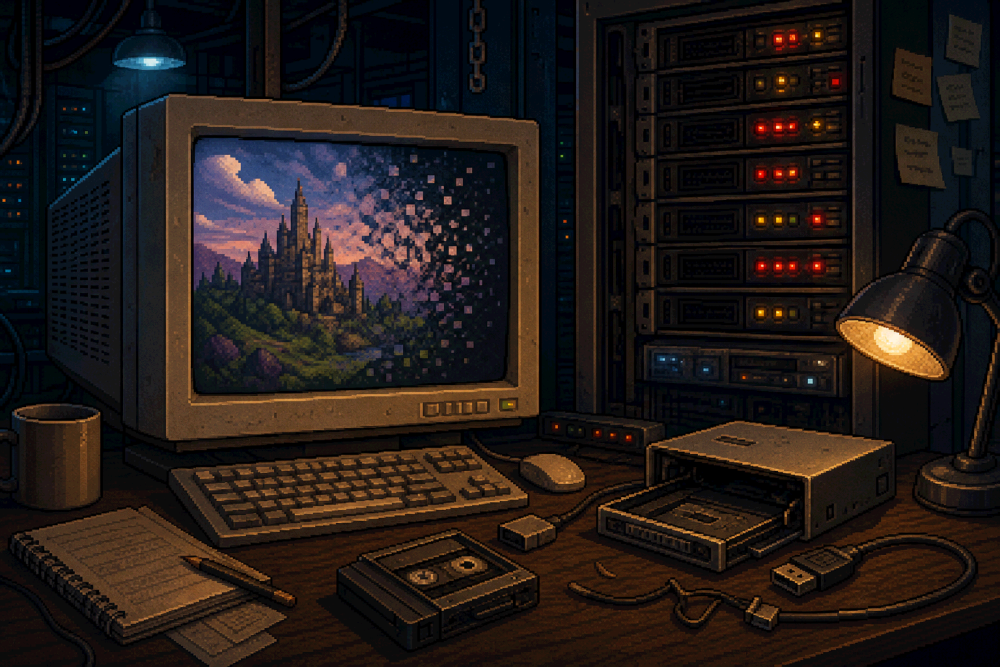
Some games do not disappear from the shop. They disappear from the world itself. In November 2011, that is exactly what happened to the Japanese online game M2, which reports said was lost for good after server data was wiped during emergency work and no usable backups remained.
It almost sounds too clumsy to be real. An online game is a service, after all, with servers, storage, redundancy and backup copies. In theory, yes. In practice, smaller online titles often reveal how thin the technical and organizational safety net can really be.
According to Japanese and international reports, M2 had already been struggling with major server problems. During emergency repairs, the relevant game data was reportedly erased. The developer then said recovery was no longer possible. That meant not just the end of the service, but the loss of the world itself: characters, progress, account data and the full play environment into which people had poured time and money.
With physical games, people still understand preservation fairly instinctively. A box can sit on a shelf, a disc can be dumped, a manual can be scanned. With an MMO or another online game, the idea feels more abstract. As long as the servers stay online, everything seems safe enough. Until it turns out that almost none of it is in the player's hands.
That is why the M2 story lands so hard. It shows that an online game does not only disappear because revenue falls short or the publisher schedules a shutdown. It can also vanish through technical failure, weak management or an emergency procedure gone wrong. In that case, there is not even a neat farewell or sunset plan. There is mostly just a hole where the game used to be.
For the affected players, that was first of all simply frustrating. A game into which time, attention and often microtransaction money had been invested disappeared without a meaningful way back. Reports at the time mentioned selective compensation, but the details remained vague. Even if the financial side had been handled perfectly, that still would not bring the world itself back.
For GamingPlanet, that second point is what makes the story really interesting. When an online game disappears, you do not only lose a product or an account. You also lose a piece of game history that later becomes very difficult to reconstruct properly.
An online world is more than a client file. Server logic, economy, events, social structures, updates and even small balancing choices all shape what the game actually was. If only the installer survives, the experience itself does not. In M2's case, the reports made that painfully clear: apparently not even enough remained to rebuild the service technically.
That makes stories like this more important than they first appear. Big names may still attract fan servers, archive projects or retrospective attention years later. Smaller online games disappear much more quietly. They existed, people played them, people paid into them, and then it becomes surprisingly hard even to explain how that world really worked.
The news around M2 comes from 2011, but the subject hardly feels old in 2026. If anything, it feels more current. As more games live as services, accounts, patches and temporary seasons, the dependence on servers and platform management only grows.
That is why this story fits GamingPlanet so well. It touches the same core issue as Stop Killing Games, always-online DRM, private servers and the question of what a player still owns once a game mostly lives outside their own hardware. M2 is almost an extreme example of that: not a complicated legal conflict, but the blunt fact that badly preserved online infrastructure can take a whole game down with it.
That may be the most important lesson. With online games, preservation does not start once a title earns cult status. It starts much earlier, with documentation, backup discipline, technical care and a willingness to treat a game not only as a live service, but as something that should still be understandable later.
If we only preserve what is still profitable today, we usually discover too late how much has quietly fallen through the cracks.
Sources: J-CAST News, November 15, 2011 and Engadget, November 15, 2011.
Tags: News, Preservation, PC, Game ownership
 ,
,
 ,
,
 ,
,

Copyright © 2008-2026, GamingPlanet.nl