
(Illustration: GamingPlanet.nl)
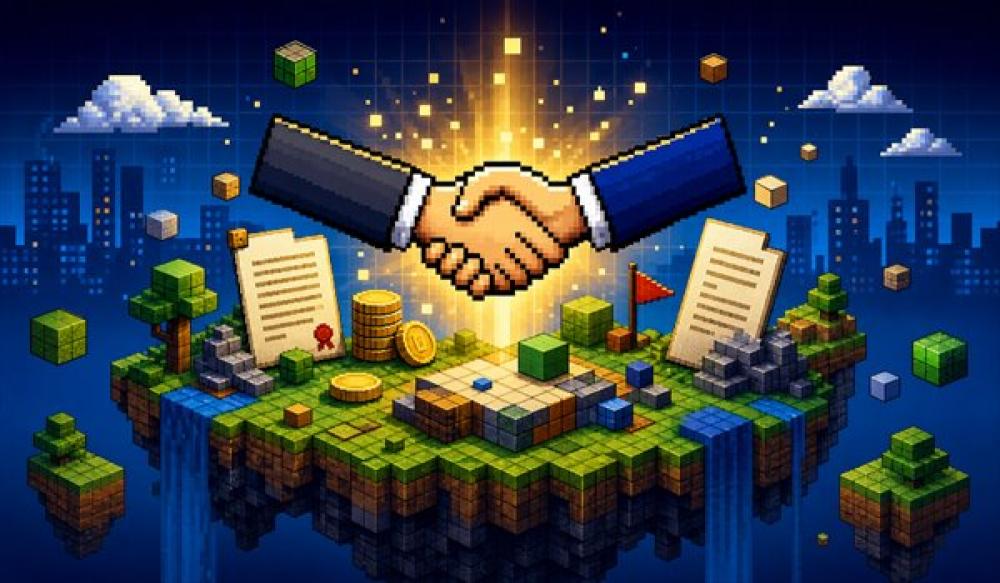
Microsoft has found a way to buy an almost infinite world: put $2.5 billion on the table and hope the Creepers respect the contract.
Last week's rumours were true. On 15 September 2014, Microsoft announced that it had reached an agreement to acquire Swedish developer Mojang, including Minecraft and the rights attached to it. The deal is worth $2.5 billion. Subject to the usual reviews and approvals, the acquisition is expected to close later this year.
That is an extraordinary amount of money for a studio that was known only a few years ago for an angular PC game in which the first night often ended inside a hole in the ground. Microsoft is not merely buying a game, however. It is buying a brand, a community, a development platform, an enormous number of player-made worlds and probably the only digital product capable of presenting a block of dirt as a serious construction material.
For players, the first question is simpler: what will Microsoft do with Minecraft?
Minecraft began in 2009 as a small and unusual project by Markus "Notch" Persson. Its graphics looked old-fashioned even then. There was no elaborate story, no carefully directed campaign and no stern soldier on the cover staring past an explosion.
You got blocks.
Those blocks turned out to be remarkably flexible. Players dug tunnels, built houses, created redstone machinery and reshaped entire landscapes because one hill was a single block too far to the left. The game spread through word of mouth, YouTube videos, mods, private servers and people enthusiastically explaining why they had spent until three in the morning looking for virtual coal.
Microsoft now calls Minecraft one of the most popular games in the world. According to today's announcement, the PC version has been downloaded more than 100 million times since 2009. On Xbox 360 alone, players have collectively spent more than two billion hours in the game over the past two years.
Those are no longer the numbers of a small independent experiment. Those are numbers that make even Microsoft reach for a calculator.
Once the deal is completed, Mojang will become part of Microsoft Studios, alongside the teams and franchises behind titles including Halo, Forza and Fable. Microsoft particularly points towards its experience with cloud technology, mobile devices and online connections. That could produce richer and faster worlds, stronger development tools and more ways for players to connect.
It sounds tidy in a press release. The real ownership of Minecraft is not quite as easy to place inside a server folder.
Much of the game's value lives with its players. It is in buildings Mojang never designed. In mods adding features before the official game reached them. In survival servers with their own rules, adventure maps, texture packs, YouTube channels and children who are already better at block-based town planning than some real councils.
Microsoft is buying the name, the code and the right to decide its commercial future. It does not automatically receive the trust of everyone who made Minecraft enormous.
Microsoft becoming the owner immediately raises the question of whether Minecraft will eventually become primarily an Xbox and Windows product. Minecraft is not limited to PC and Xbox. It is also sold on PlayStation, iOS and Android.
Microsoft is trying to calm that concern immediately. The company says it plans to keep Minecraft available on every platform where it exists today: PC, mobile devices, Xbox and PlayStation. Mojang is more specific, naming the PC and Mac versions, Xbox 360, Xbox One, PlayStation 3, PlayStation 4, PlayStation Vita, iOS and Android.
That is an important answer, although it is not a lifetime guarantee carved into obsidian. Microsoft cannot predict what other platform holders may decide later, and nothing has yet been said about future Minecraft games or new expansions.
For now, PlayStation players do not need to pack their blocks into moving boxes.
The acquisition also marks the end of Mojang's current leadership. Markus Persson, Carl Manneh and Jakob Porsér will leave when the deal is completed. Most of the studio's other employees are expected to remain for the time being.
Notch's departure in particular will matter to many players. He is not only Minecraft's original creator. As the game grew, he also became an accidental public representative of independent game development. Every comment was discussed as though he had not simply posted something online, but had stepped onto a balcony to announce policy for every small developer in the world.
Persson explains today that, for him, the sale is not primarily about money. The pressure of a company and a game with global significance has become too much. He would rather be a programmer making small experiments than the face and manager of an international phenomenon.
That is understandable. Starting a game because you enjoy building systems is very different from waking up as the majority shareholder of a company Microsoft values at $2.5 billion. At some point your inventory stops containing wood, stone and iron, and fills instead with lawyers, contracts and people who say "strategic synergy" without laughing afterwards.
Minecraft fits the direction Microsoft is taking under chief executive Satya Nadella. The game is active on computers, consoles, tablets and phones. Players make their own content, play together and often keep returning for years. Microsoft therefore describes Minecraft not only as a game franchise, but as an open-world platform.
The appeal for Xbox is obvious. Microsoft says Minecraft is the most popular online game on Xbox, and players have invested a remarkable amount of time in it. At the same time, Minecraft is strong on devices where Microsoft itself is less dominant, including iOS and Android phones and tablets.
The purchase therefore gives Microsoft more than a successful Xbox title. It reaches an audience that pays little attention to the usual boundaries between PC, console and mobile. Minecraft players mainly want to know where their world is and whether their friends can enter it. The logo on the device is generally a marketing department's problem, not the Creeper waiting outside the front door.
Microsoft also expects the acquisition to become break-even during its 2015 financial year. That is an ambitious expectation for a price with nine zeroes, but Minecraft sells more than games. The brand already surrounds toys, books, clothing and events, while its community produces free publicity every day by sharing buildings, videos and stories.
For PC players, the biggest uncertainty is probably not whether Minecraft will still start tomorrow. The more interesting question is what happens to the open structure around it over time.
Minecraft became enormous in an environment where players could organise a surprising amount themselves. They run their own servers, alter the game with mods and build entire game modes on top of its original rules. None of it is always simple, officially supported or free from arguments, but that untidy freedom is part of Minecraft.
Mojang says that stopping players from making cool things would be in nobody's interest. The team also intends to keep communicating personally with the community as it has done until now.
That is reassuring. The question remains how such a culture will behave inside a corporation of Microsoft's size. Large companies like clear platforms, fixed accounts, manageable shops and terms that were not drafted by somebody replying to a forum at two in the morning. Minecraft grew precisely because not everything was neatly controlled from the centre.
The best outcome would be for Microsoft to add technology, reach and resources without immediately gluing every loose block to the floor.
$2.5 billion remains difficult to comprehend. Minecraft has no traditional campaign that ends after twelve hours and no fixed world that can ever be completed. It effectively sells tools and rules, after which players create most of the content themselves.
Perhaps that is exactly why Microsoft is paying so much.
A conventional successful game may receive a sequel after a few years and then slowly disappear from view. Minecraft behaves more like digital construction toys. New players do not need to know five earlier instalments. A child can begin today with a wooden house, while somebody else attempts to build a working computer from redstone and a third player is still angry because their sheep has vanished.
That broad appeal does not make Minecraft indestructible. A bad direction, excessive control or lost trust could damage the community. It does explain why Microsoft is not waiting for Minecraft 2. It is buying a game that never needs to be finished.
The acquisition was announced today, but has not yet been completed. Until the deal closes later this year, much remains unclear. We know the founders will leave. We know Microsoft intends to support the existing platforms. And we know that $2.5 billion is on the table for a company that began with one peculiar block-building project.
What we do not know is how Minecraft will feel under Microsoft. Will Mojang retain the same directness? Will mod makers and server operators keep their room to experiment? Will the different versions move closer together? And can one of the largest technology companies in the world avoid treating a community as though it consists only of customers?
Microsoft bought Minecraft today.
Now it needs to show that it understands why nobody thought the game belonged only to Mojang.
Sources: Microsoft: Minecraft to join Microsoft, Xbox Wire: Minecraft joining Microsoft, The Guardian: Minecraft sold, Microsoft buys Mojang for $2.5bn.
Tags: News, Microsoft, Minecraft, Mojang, Game ownership, PC, Xbox, PlayStation