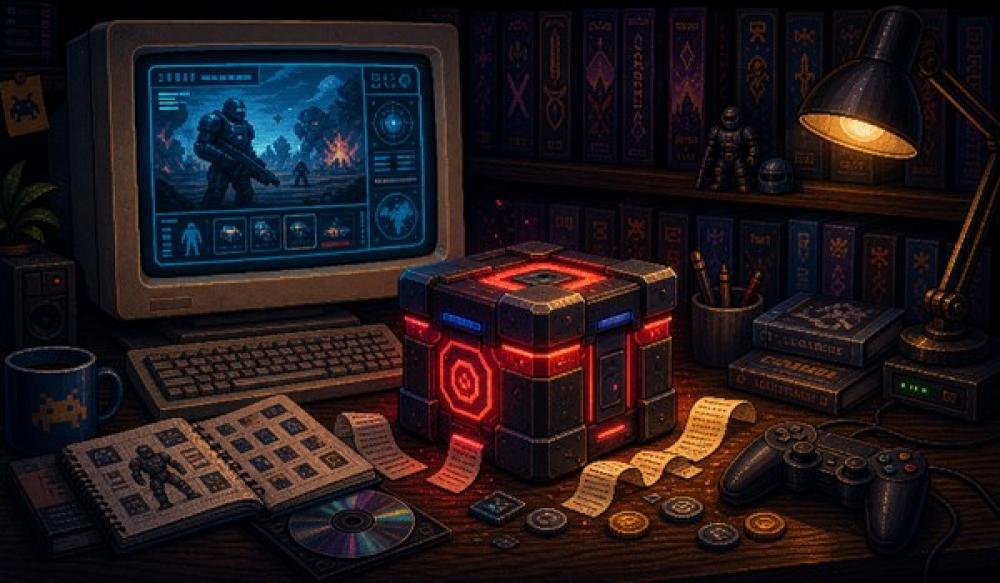

(Illustration: GamingPlanet.nl)
Star Wars Battlefront II launches today without the real-money purchases a major part of its progression system appeared to be built around. Even the Death Star took longer to blow itself up.
This was supposed to be the grand return. A new campaign, space battles, conflicts from all three Star Wars eras and no traditional season pass splitting players across different maps after launch. Electronic Arts and developer DICE had clearly listened to some of the criticism directed at 2015's Battlefront.
When it came to the business model, they apparently listened to somebody else.
In the days before release, Star Wars Battlefront II changed from a promising Star Wars shooter into the centre of an unprecedented argument about loot boxes, progression and paid advantages. EA therefore disabled all in-game purchases overnight. Its virtual currency, Crystals, can no longer be bought, and all progression must temporarily be earned through play.
That is an extraordinary reversal, especially as the game officially arrives today on PC, PlayStation 4 and Xbox One. Publishers normally spend launch day explaining why everybody should buy their game. EA is instead explaining why a major part of its economy has been boarded up at the last moment.
Loot boxes are no longer an unfamiliar idea. Players open a digital crate and receive a random selection of items. In the least controversial form, those items are cosmetic: another appearance, an emote or a victory pose. Your character looks different but does not shoot any harder.
Battlefront II went further.
Its crates contain Star Cards. These cards alter or strengthen abilities for troopers, heroes and starfighters. One may shorten an ability's cooldown, while another increases damage or improves its effect. Higher card levels provide larger advantages.
Star Cards can be earned and crafted, but the system revolves heavily around random crates. Before last night's intervention, players could buy Crystals with real money and use them to open additional crates. The question was therefore not only who had played the most, but who had opened their wallet most often and then been lucky.
That moves dangerously close to pay-to-win. Not because somebody could order Darth Vader directly with a credit card, but because money increased the opportunity to obtain stronger cards and faster progression. In a competitive multiplayer game, “it is random” is not a particularly comforting defence. A slot machine does not become fairer because it sometimes gives you nothing.
Anger grew when early-access players began calculating the economy. Famous heroes and villains were not all immediately available. Luke Skywalker and Darth Vader initially required 60,000 Credits each to unlock.
Based on earnings per match, players estimated that obtaining one of those characters could take dozens of hours. One widely shared calculation suggested around forty hours. That is not an impossible goal in an online game intended to last for years, but it felt strange in a full-price Star Wars title where Darth Vader is a major part of the appeal.
The Deluxe Edition also costs more and was sold with earlier access and upgrades for several trooper classes. Before the general release, players already felt as though they had bought an expensive ticket to a theme park where the famous attractions were still placed behind a separate and very long queue.
EA responded on 13 November by reducing the Credit cost of the main heroes by 75 percent. Luke and Darth Vader now cost 15,000 Credits. Emperor Palpatine, Chewbacca and Leia Organa dropped to 10,000, with Iden Versio at 5,000.
This made unlocking them considerably faster. It did not answer the larger question of why the original figures had been so high, or why the rest of the progression system was constructed so heavily around crates and randomness.
A reply from EA's official community team on Reddit meanwhile turned into an internet monument of its own. A player complained that Darth Vader remained locked after buying the game. EA responded that unlocking heroes was intended to provide players with a sense of “pride and accomplishment”.
The community then demonstrated another form of engagement.
The reply received hundreds of thousands of negative votes in a remarkably short time and became the most downvoted comment in Reddit history. Its precise score continued to fall while screenshots and jokes spread across the internet. A phrase probably intended as a tidy explanation from a community handbook became the standard response to almost every new discussion about the game.
Some of that is simply how the internet behaves. Once a company produces an unfortunate sentence, people will repeat and enlarge it forever. The joke worked because it matched the impression that EA had designed a long progression track and then presented it as something players should appreciate.
Pride and accomplishment are perfectly good things. They work better when they come from doing something difficult, rather than from a spreadsheet calculating how many evenings should sit between you and Darth Vader.
There is an understandable idea behind the original model. The 2015 Battlefront used a season pass. New maps and modes arrived inside paid expansions, splitting the player base between people who did and did not own the additional content.
Battlefront II removes that traditional season pass. New maps, heroes and other additions are meant to be provided to players for free. That is a clear improvement in itself: friends do not need to compare lists of purchased packs before discovering whether they can enter the same mode.
Developing new content obviously costs money. EA selected microtransactions as an ongoing source of revenue. The problem is not that a publisher may never earn anything after the first sale. The problem is what it decided to sell.
Cosmetic items allow players to display preferences without changing a match. Battlefront II connected paid randomness to cards affecting performance. The business model therefore became part of the balance. Every adjustment to a card, reward or crate then affects not only the game, but a product somebody may have purchased with real money.
An economy running through everything is very efficient until it needs to be removed. Then you discover that almost every pipe passes through the same wall.
DICE general manager Oskar Gabrielson writes in the official statement that the company has heard concerns about unfair advantages and recognises that the argument is overshadowing the rest of the game. EA and DICE say they need more time to listen, adjust and improve the balance.
All in-game purchases have therefore been disabled. Crystals can no longer be bought and progression will, for now, be earned entirely through gameplay.
“For now” is important.
EA explicitly says the option to purchase Crystals will return at a later date, but only after changes have been made. What those changes are, when the system will return and whether Star Cards can still be obtained through paid crates are all unknown today.
The loot boxes themselves have not disappeared from the game either. They remain part of progression; nobody can currently buy extra chances with real money. The window is closed, but the shop is still there.
The frustrating part is that Battlefront II contains many of the right answers on paper. This time there is a single-player campaign, with Iden Versio and Inferno Squad providing a new perspective on the end of the Empire. Multiplayer spans the prequels, original trilogy and newer films. Criterion built the space battles, and the game supports ground conflicts for up to forty players.
Visually, Battlefront is once again immediately recognisable as Star Wars. Lightsabers cut through smoke, TIE Fighters scream past wreckage and troopers are thrown through doorways in exactly the correct cinematic manner. DICE can make a laser bolt sound as though you were already afraid of it as a child.
Almost nobody is discussing the campaign, maps or starfighters this week, however. The conversation is about crates, Credits, percentages and whether a player with more money can also buy more power.
EA caused that itself. A business model should support a game. Here it became so prominent that the product it was meant to finance disappeared behind it.
By disabling purchases, EA has temporarily removed the most immediate pay-to-win concern. Nobody can spend money today to collect more Star Cards more quickly. That makes the version launching now fairer than the one offered during early access.
It is difficult to see this intervention as a complete solution. The economy was designed with Crystals and paid crates in mind. With part of it suddenly missing, we now have to discover whether the remaining progression feels enjoyable or merely like a shop whose cash register is temporarily broken.
EA also has a problem of trust. Every future change will be examined for whether it improves the game or merely makes the microtransactions saleable again. That is not a comfortable starting point for a live service relying on an active community for years.
Perhaps DICE will change the system thoroughly enough. Perhaps the core game will prove strong enough to survive this week. On 17 November 2017, all we know is that one of the world's largest publishers had to close the shop inside one of its most important games immediately before release because players could see too clearly what was being sold.
The Battle of Hoth takes around twenty minutes.
The battle for players' trust may take a little longer.
Sources: Electronic Arts: An Update on Star Wars Battlefront II, Electronic Arts: Battlefront II launches on 17 November 2017, EACommunityTeam on Reddit, PC Gamer: hero costs reduced by 75 percent.
Tags: News, Electronic Arts, Star Wars, Loot boxes, Game ownership, FPS, PC, PlayStation, Xbox