
(Illustration: GamingPlanet.nl)
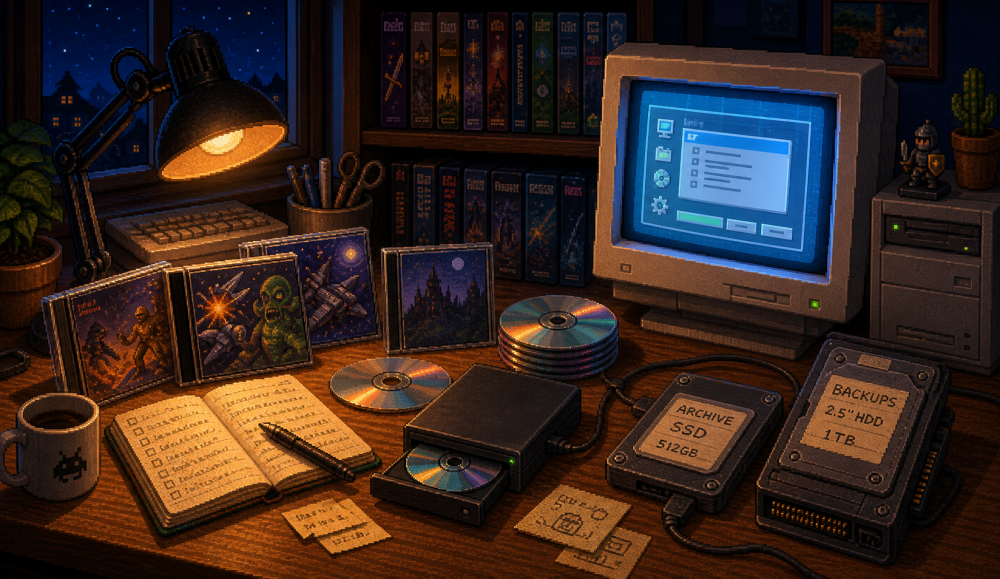
While major publishers are increasingly comfortable dropping boxes, discs and bundled media, something interesting is happening on the other side. Some PC players are moving back toward tangible editions. Not necessarily through official big boxes, but through homemade discs, custom cases, offline installers and even SSD or HDD cartridges as a modern form of physical ownership.
At first that sounds like a niche inside a niche. It still touches exactly the question that keeps returning on GamingPlanet: what do you do when you want a game not only to run today, but also to remain preservable, reinstallable and at least somewhat yours when stores, launchers and licences keep becoming more central?
PC Gamer wrote on July 15, 2026 about how GOG reminded players that PC gaming still leaves room to keep an offline copy of your own. GamesRadar then showed on August 12, 2026 how preservationist Ryan Enstrom, through Archades Games, is assembling physical PC releases using discs and even mechanical hard drives as swappable media. These are different stories, but they strike the same nerve.
On consoles, ownership is increasingly compressed into an account, a store page and a download button that works only as long as the platform allows it. The PC is moving in that direction too, but less absolutely. Because some stores still offer offline installers, and because files on a computer are not locked down quite as tightly, there is still room for a different relationship with games.
That difference looks small when everything works. It becomes much clearer when a launcher disappears, a store replaces a version, DRM changes or a game needs to be installed again years later. Then it suddenly becomes obvious how useful it is when a player still has a proper installer, a labelled disc or a carefully prepared archive copy of their own.
That is exactly why building physical PC editions by hand feels less strange than it first sounds. It is not only a nostalgia exercise. It is also a practical response to a market in which the tangible layer keeps getting thinner.
The nice thing about projects like this is that they do not pretend time stood still. Nobody needs to believe that a burned disc or an SSD in a case suddenly becomes the exact same thing as an official big box from the 1990s. It does not.
What it does bring back is control. A personal physical copy gives the player something to hold again. An installation set that is not tied to one fleeting online moment. A medium that can be labelled, archived, checked and used again later without first hoping that a store or account still lets you in.
There is also a cultural side to that. A game becomes an object with context again. Not only an icon in a library, but a combination of files, notes, artwork, versioning and choices made by the owner.
For game preservation, that matters more than shelf aesthetics alone. Good preservation is about context. Which build was this? Which patch belonged to it? Was this the offline installer from the time, or a later replacement? Did it include notes, a changelog or installation instructions that someone added by hand?
A homemade physical PC edition can sometimes preserve that context better than a bare download folder sitting on a random drive. Not because it is technically superior, but because people tend to treat it more seriously once it has a clear form. A case, label or organized folder structure almost forces description and order.
That is exactly why this goes beyond craftiness. It touches the discipline of archiving. It is the difference between "I think I still have a copy somewhere" and "I know what this is, which version it is, and how I can make it work again later".
That does not mean homemade physical copies solve everything. Modern PC games can still depend on online activation, accounts, day-one patches, servers or anti-cheat layers that let local ownership preserve only part of the story.
So a disc or SSD edition is not automatically a miracle cure. Sometimes what you preserve is mainly an installation path rather than the full play experience. Even that is still much better than nothing at all. Quite often, that first step is the difference between being able to reconstruct something later and only knowing that it once existed.
That is why this trend feels both sympathetic and important. Not because everyone should start burning their Steam library tomorrow, but because it shows that players are not fully satisfied with a world where ownership survives only as a permission slip.
GamingPlanet has been living at this intersection for a while already. We care about boxed PC games, manuals, hardware and the tangible edges of gaming history. At the same time, we know the modern PC market is not going back to the oversized cardboard box as its standard form.
That is exactly why this is such a strong topic. It shows that the desire for physical grip has not disappeared; it has simply changed shape. Sometimes it becomes an official reissue, sometimes an archive folder, sometimes a neat stack of custom discs with a printed cover and a note about which offline installer still worked.
That may be less glamorous than the golden age of the big box, but it is alive. And living heritage is often more valuable than a perfect idea of how things were supposed to stay.
Sources: PC Gamer, July 15, 2026, GamesRadar, August 12, 2026.
Tags: News, PC, Preservation, Game ownership, Hardware
 ,
,
 ,
,
 ,
,

Copyright © 2008-2026, GamingPlanet.nl