
(Illustration: GamingPlanet.nl)
The debate around Sony and the disappearance of new PlayStation discs moved another step this week. What first sounded like a bleak headline for collectors is turning into a broader fight over pricing, resale, and how much room players still have inside a fully digital system.
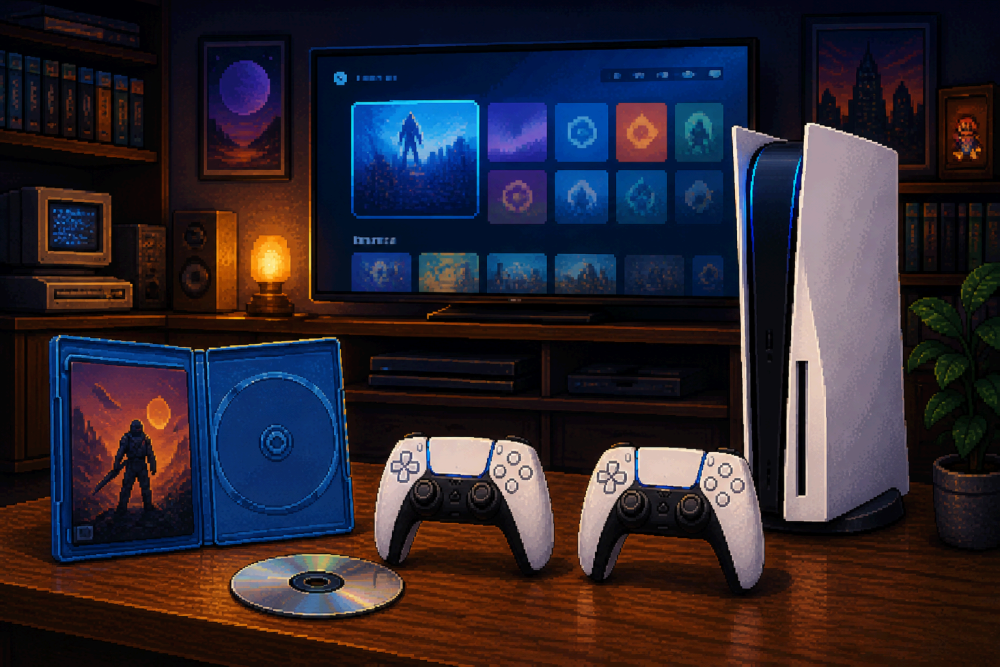
On July 1, 2026, Sony announced that it would stop producing physical discs for new PlayStation games from January 2028 onward. Existing releases are not affected, but for future titles the road after that point clearly leads in one direction: digital only.
That news already triggered plenty of backlash. Understandably so. For many players, a disc is still more than nostalgia or shelf decoration. It is a physical version of a game that can be price-compared, bought second-hand, lent out, or sold later. That practical side does not vanish just because a company says the market has gone digital.
This week, that unrest took on a sharper form. According to PC Gamer and GamesRadar, both Stop Killing Games and DoesItPlay? have now joined the Dutch case against Sony over its digital sales model. That shifts the story away from disappointed fans alone and into consumer rights and game preservation.
The Dutch action has already been arguing that PlayStation users systematically pay too much for digital games because Sony controls the store on its own platform. That is already a serious subject. Once new discs disappear, it becomes easier to feel in practice.
As long as physical editions still exist, there remains at least a second track beside the PlayStation Store. Players can compare prices between online retailers, local shops and the used market. That puts at least some pressure on the platform holder. If that physical track disappears, Sony is not only the keeper of the account and the platform, but almost automatically the gatekeeper for every new purchase too.
That makes the discussion immediately more concrete. This is not about romantic shelf aesthetics. It is about room to choose. About whether a player can still go somewhere else if the official store price feels wrong. And about what remains of ownership when everything ends as a licence inside the same closed system.
It is fair to say that a modern disc is not automatically the ideal preservation format. Some games are incomplete on disc, need large patches, or depend heavily on online services. A box alone does not magically solve that.
That still does not mean every form of distribution is effectively the same. A disc preserves something that a download code or account licence does not preserve: transferability. Even an incomplete physical release can still exist as an object to resell, collect, document, or rediscover later outside the platform holder's own store.
A digital purchase in the PlayStation Store ultimately becomes permission inside Sony's own ecosystem. Convenient, quick and already normal for many players. It is also more dependent. Once prices, terms, or availability change, the player has no second route left to fall back on.
That is exactly why it matters that groups like DoesItPlay? and Stop Killing Games are stepping into the conversation. Their point is not simply that physical games feel nicer. Their point is that digital control on consoles increasingly overlaps with loss of freedom, loss of transferability and, eventually, loss of history.
DoesItPlay? has spent years examining whether physical releases are actually usable without mandatory downloads or servers. Stop Killing Games has been pressing on another sore spot: what does ownership still mean if a game can become unusable after sale or remain entirely locked to an account?
Those questions now meet in the same place. A fully digital console market makes it easier for companies to centralize distribution. That may be efficient for the industry, but it is rarely in the interest of the player who wants to compare prices, pass something on later, or simply avoid having every game end as a line in one online library.
On paper, Sony's story is understandable. The market is mostly digital, physical manufacturing costs money, and modern players often buy directly through the console already. From a logistics and margin perspective, this is a neat and predictable step.
A trend does not automatically mean the older choice had become worthless, though. People often buy digitally because it is fast, not because every alternative suddenly stopped mattering. Sony is now using that shift to remove one existing route entirely.
That changes the tone of the debate. The question is no longer only whether players like the decision. It becomes whether a platform holder accumulates too much power once physical alternatives disappear. Not only over price, but over visibility, terms and the way access to a game is managed in the long run.
Anyone who follows GamingPlanet a little will see why this fits here so well. We have been writing for some time about physical PC games, the second-hand market, boxed releases and the practical side of game preservation. In that sense, this is a very natural next chapter.
The more digital distribution becomes, the more the remaining tangible routes matter. Not because every box is sacred, but because history usually turns out messier than companies expect in advance. Nobody knows on launch day which game will still feel culturally, technically or emotionally relevant fifteen years later.
That is exactly why it is risky when one distribution format disappears before we even get the chance to learn what we might have wanted to preserve through it.
It is entirely possible that this case will not make Sony change course immediately. Large companies rarely move fast. The discussion is already different from July, though. Then it was mainly about a decision. Now it is about the consequences of that decision.
And those consequences do not only touch collectors. They affect everyone who wants a purchased game to remain more than a line inside a store managed by somebody else.
Sources: PlayStation Blog, July 1, 2026, PC Gamer, August 13, 2026, GamesRadar, August 11, 2026, Push Square, July 10, 2026.
Tags: News, Sony, PlayStation, Game ownership, Preservation
 ,
,
 ,
,
 ,
,

Copyright © 2008-2026, GamingPlanet.nl