
(Illustration: GamingPlanet.nl)
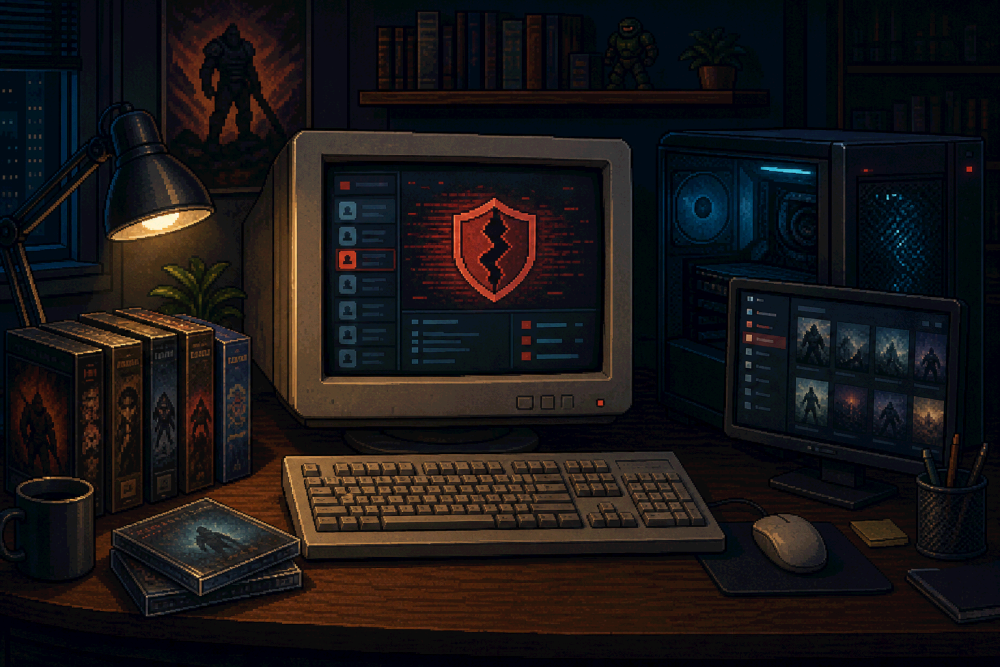
In November 2011, the news at first seemed fairly contained: the Steam forum had been hacked and temporarily taken offline. A few days later, the story became more serious. Valve said the intrusion went beyond the forum itself and that a Steam database had also been accessed.
Looking back, that moment feels like an early warning for something GamingPlanet keeps returning to. Once a game library mostly lives inside accounts, stores and platform services, security becomes part of game ownership as well. Then it is no longer only about a forum going down. It becomes a question of trust in the layer where purchases, passwords and access all meet.
Valve wrote at the time that the forums had been defaced on November 6, 2011, and that the investigation later showed intruders had also gained access to a Steam database. According to that message, the database included user names, hashed and salted passwords, game purchases, email addresses, billing addresses and encrypted credit card information.
A hacked forum is unpleasant, but still relatively easy to frame. People think of spam, vandalism or a discussion space being shut for maintenance. With Steam, that picture shifted quickly because the forum was not separate from a much larger ecosystem. Behind the discussion board sat a platform where people bought, activated, tracked and trusted their games as a digital shelf.
That changes the tone immediately. When a platform holder has to say that not only forum posts, but potentially purchase data and account information were exposed, a digital library suddenly feels much less automatic. The games may still be sitting in your list, but the calm around that list is gone.
Valve said it had no evidence at the time that encrypted credit card numbers had been misused or that passwords had actually been cracked. Even so, the message was clear enough: watch your statements, change forum passwords and think carefully about password reuse on other services. That shifted the incident from technical inconvenience to something that touched the everyday use of a game platform directly.
For physical collectors, that may almost sound obvious. A box on a shelf does not require database trust to remain visible. A Steam library does. Not because digital is automatically bad, but because the player becomes dependent on several invisible layers at once: account security, payment data, platform continuity and the integrity of the system that grants access.
That is why this old Steam breach matters as more than just security news from 2011. It showed early on that digital distribution is more than convenience. It is also a shift from ownership toward managed access. Players still have entry to their purchases, but that access hangs from a technical and organizational infrastructure they barely control themselves.
That makes the story broader than Valve alone. Anyone who later argued about always-online DRM, account-bound purchases or disappearing stores will recognize the same pattern here in an earlier form. The problem rarely starts only when a game is removed. It starts the moment everything you own is gathered inside one central system.
GamingPlanet likes writing about physical PC games, big boxes, discs, manuals and the messy practical side of preservation. Not only out of nostalgic instinct, but because tangible formats keep a second route open. An account library often does not. If something goes wrong with access, security, terms or infrastructure, almost everything is tied into the same chain.
That is why older platform incidents like this are worth revisiting. Not to become cheaply alarmist about digital distribution after the fact, but to show in a calm way where the vulnerability really sits. A forum hack that turns into concern about the underlying database is exactly the kind of moment that makes modern game ownership more transparent than companies usually like.
It is also a useful reminder that preservation is not only about storing the game files themselves. It is also about the surrounding structures: accounts, licences, platform security and the question of how much real control a player still has once the whole library is arranged digitally.
Sources: Valve: Message from Gabe to Steam Community, November 11, 2011, Kotaku, November 7, 2011.
Tags: News, Steam, PC, Game ownership, Preservation
 ,
,
 ,
,
 ,
,

Copyright © 2008-2026, GamingPlanet.nl