
(Illustration: GamingPlanet.nl)
P.T. really is called P.T.. Not "Project Teaser", not "Playable Trailer", but simply Playable Teaser. That only makes it more ironic that this downloadable teaser is already harder to find than many full games.
The PlayStation 4 demo P.T. has not only disappeared from the PlayStation Store. Players are now reporting that the teaser can no longer be re-downloaded even if it had previously been added to their library. Anyone who still has it installed on the hard drive can continue playing for now. Anyone who deleted it or needs to reinstall the system appears to be out of luck.
That instantly turns P.T. into more than a vanished demo. It is now a painful example of how fragile digital game ownership really is. Or rather, digital "ownership", because that is exactly the word that starts shifting suspiciously fast here.
P.T. appeared unexpectedly on PlayStation 4 in August 2014 as a seemingly separate horror project from an unknown studio, 7780s Studio. Players walked through a repeating corridor, solved cryptic puzzles and discovered at the end that it was a teaser for Silent Hills, the new project from Hideo Kojima and filmmaker Guillermo del Toro, starring Norman Reedus.
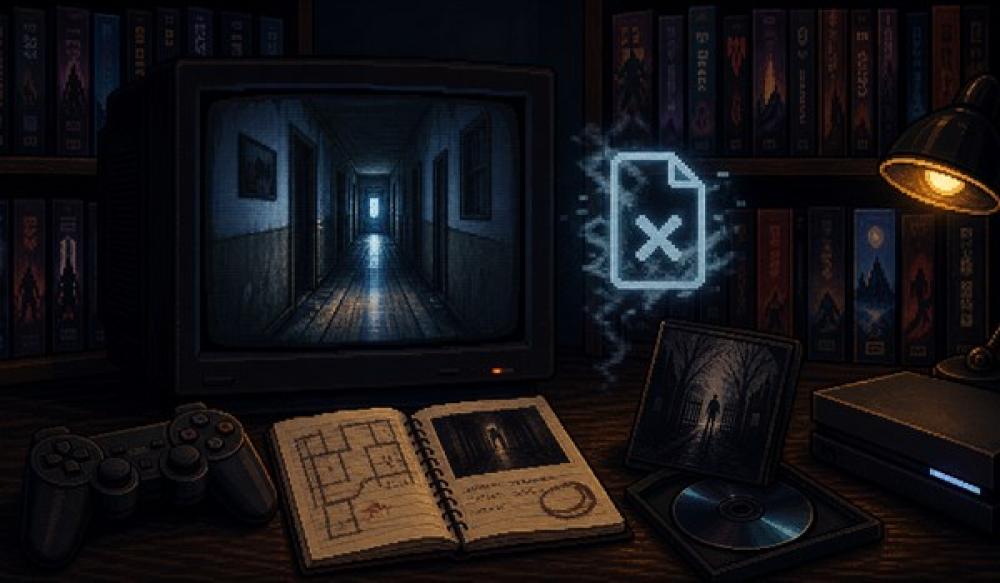
Sony suddenly had something on the console that half the internet threw itself at. Not because it lasted for hours or contained an endless feature list, but because almost nobody knew what exactly was going on. P.T. was simultaneously a riddle, a marketing stunt and one of the scariest hallways in the history of interior design.
The teaser also quickly became a cultural object in its own right. Streamers, forums and YouTube videos helped unravel the puzzles, while players kept discussing hidden details and the ending. That is already unusual for a demo. It is even more unusual that people are now discussing it as though an entire game has been lost, when it was officially never more than a teaser.
That P.T. was under pressure had already become clear in recent weeks. Konami confirmed at the end of April that Silent Hills would not go ahead. Shortly afterwards it also became known that P.T. would be removed from the PlayStation Store.
At that point the situation still seemed disappointing, but not exceptional. Digital demos disappear from stores fairly often. Many players assumed the teaser would at least remain re-downloadable for anyone who had previously "purchased" it or added it to their library. That now appears not to be the case.
This is precisely where the story changes from unfortunate to important. Removing a download from the store is one thing. Closing it off afterwards even for people who had already linked it to their account feels like something else. You are not only reducing access for new players, but also removing an existing route to the software.
The convenience of a digital library is misleading. A game or demo sits neatly in a list under your account name, often next to a download button and sometimes even the word "purchased". That gives the impression that the product is now simply yours, in the same way a disc is yours once it is sitting on the shelf.
P.T. shows that this impression is not entirely correct. The download may still technically exist, the game may even have been previously acquired by the player, but access remains dependent on the willingness of the platform holder and publisher to keep that route open.
That does not make digital distribution worthless. It makes it conditional.
In practice, the player does not possess an independent object, but a combination of account access, platform policy, licence terms and a still-available server. As long as all those links remain in place, it feels almost identical to ownership. Once one of them is removed, the floor suddenly turns out to be much thinner than it looked.
The interesting part of this story is that it does not concern a major MMO, a subscription or an online service that everybody understands will stop one day. P.T. is a relatively small downloadable single-player teaser. No giant infrastructure. No permanent service. No complicated ecosystem requiring a hundred servers to stay alive.
That is precisely why this disappearance lands so hard. If even a small horror teaser can so easily fall out of reach, what does that say about larger digital games depending far more heavily on account systems, patches and servers?
In that sense, P.T. is almost a textbook example. The file was real. It ran locally on the console. It had been downloaded by the players themselves. And yet none of that proves sufficient to guarantee continued access.
That is quite a lesson in digital game ownership, especially for something that began as a corridor with a talking radio and many people making extremely questionable decisions by looking around the corner one more time.
The situation is also giving consoles with P.T. still installed a strange new status. An ordinary PS4 containing the teaser suddenly becomes a preserved specimen. Not because something rare was sold in a shop, but because the download has been made scarce afterwards.
That is a reversal we normally associate with physical games, limited print runs or sold-out collector's editions. With digital material, people expect the opposite: infinitely reproducible, endlessly re-downloadable and never truly exhausted. Yet scarcity has appeared here not through a lack of bits, but through policy.
Anyone who still has P.T. on the hard drive would therefore be wise not to remove it casually. That may sound dramatic for a teaser, but that is exactly what makes this so odd: by taking it away, Konami has effectively turned P.T. into a kind of digital collectible.
Some players will dismiss this by arguing that P.T. was free and therefore never really granted any rights. That is too easy. This is not only about money, but about access, expectations and the idea that a digital library functions as an archive of your software.
If a platform holder and publisher can close off a previously offered download this completely, then the usual reassuring buttons and store descriptions deserve much clearer language. Players should at least know when "download" really means "for as long as we feel like it".
P.T. was intended as a teaser for a future horror project. It has now also become a teaser for a much broader debate: what remains of digital game ownership when a file may once have existed in your list, but may no longer return to your console?
At the moment, the answer is not especially reassuring.
Anyone who still has P.T. is therefore preserving more than an unusual demo. They are also preserving a small piece of evidence that digital ownership sometimes mostly resembles ownership, right up until somebody unscrews the light from the download button.
Sources: PlayStation Blog: The Drop for 28 April 2015, Konami: official P.T. page, and Konami statements regarding the cancellation of Silent Hills and the removal of P.T. from the PlayStation Store.
Tags: News, Sony, PlayStation, Game ownership, Preservation, Konami, Silent Hill