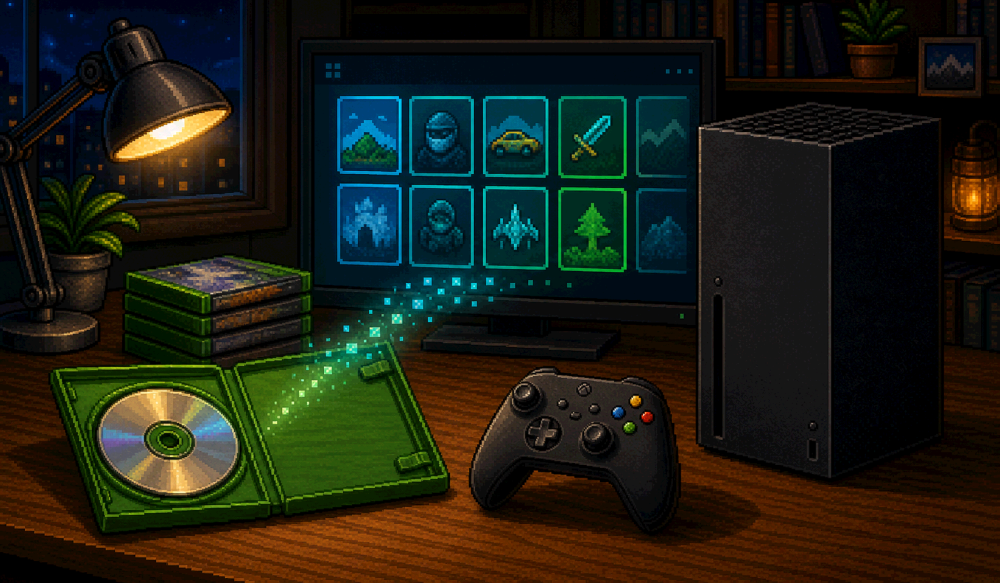

(Illustration: GamingPlanet.nl)
Microsoft did something this week that feels almost unusually decent for 2026. Soon, if you insert a supported Xbox One or Xbox Series X disc into the console, you can also claim a digital licence from it. The disc keeps working, but you gain a digital route as well. A plastic circle that is not immediately treated as an inconvenience: apparently miracles have not fully left the building.
The announcement appeared on Xbox Wire on August 26, 2026. The first test for Xbox Insiders begins on August 31, 2026. Microsoft says the feature starts with thousands of titles and supports most disc-based Xbox One and Xbox Series X games.
The process is straightforward. You insert a supported disc into an Xbox One or Xbox Series X, launch the game, and claim a digital entitlement from there. After that, where supported, you can use benefits such as Xbox Play Anywhere and Xbox Cloud Gaming. Meanwhile, the original disc continues working exactly as it always has. That last detail matters more than it may first sound.
The smart part of this move is that Microsoft is not quietly sanding the physical disc out of the picture. This is not a trade-in ritual where you smile politely while your shelf slowly loses meaning. The disc remains usable. The digital layer is simply added on top.
That makes the whole thing feel less like a stealthy push toward "everything will be account-bound eventually anyway" and more like a practical bridge. For players with shelves full of Xbox cases, that is close to a relief. You do not have to pay again to use a game in a more flexible, modern way. That does not happen often enough.
There is something almost comically healthy about that. For years, players have mostly heard why physical ownership is clumsy, expensive or old-fashioned. Now a major platform is suddenly saying: fine, keep the disc, we are just making it a little less stubborn.
For many people, this is mainly about convenience. No disc swapping when you want to continue somewhere else, no scavenger hunt when a case has vanished between old cables and forgotten manuals, and a better chance that a purchase can move with a different way of playing. On paper that may sound small. In daily use, it is exactly the kind of small that matters.
For game preservation, it is more interesting for another reason. A game that remains usable both physically and digitally depends a little less on one single format. Not perfectly, of course. A digital licence still lives inside an ecosystem controlled by somebody else. It is still an extra route, though, and extra routes are almost always better than fewer routes.
For the second-hand market, the key part is that the disc still works the way Microsoft says it always did. That removes at least some of the fear that physical ownership would become nothing more than a stepping stone toward a sealed account. The box on the shelf remains more than decoration. In 2026, that is already almost worthy of applause.
As usual, the nuance lives in the fine print. Microsoft is not saying every disc instantly becomes a golden key. This is about supported titles, and not everything is included from day one. That is understandable, but worth saying out loud before someone excitedly feeds a forgotten 2014 sports game into the tray and then glares at the television.
It also does not solve every problem around digital ownership. Licences are still licences. Stores are still stores. And a platform holder still remains the party deciding which doors stay open and which stay shut. This move improves the landscape; it does not magically make it fair.
Even so, it is hard to be cynical about it. The last few years have produced enough examples of companies treating physical media mostly as an inconvenient transition phase on the road to tighter control. Against that background, a measure that adds something instead of taking something away feels almost suspiciously polite.
That may be the heart of the story. Microsoft is not choosing purely physical, and not purely digital either. It is choosing a middle form that acknowledges what many players actually want in practice: a shelf with games and the freedom to use those games more flexibly.
This is not a romantic tale about how everything used to be better. It is something more useful. A rare moment where a major company seems to understand that convenience does not always have to begin with taking something away first.
And honestly, if we are going to keep living in an era where more and more games end up as lines inside an account, then a system that at least looks at the disc and says "you still count" feels refreshingly human.
Sources: Xbox Wire, August 26, 2026, PC Gamer, August 27, 2026.
Tags: News, Microsoft, Xbox, Preservation, Game ownership, Collecting